
Salary Growth After Product Management MBA – Real ROI
- product management
- 4 min read
Product management has firmly established itself as one of the strongest career directions in India’s technology and digital economy. With rapid expansion across SaaS, fintech, enterprise technology, consumer internet and AI driven businesses, the demand for trained product talent continues to rise. As product organisations scale, compensation structures have also strengthened, especially for professionals who invest in a Product Management MBA that sharpens their strategic and leadership capability.
This blog from the Institute of Product Leadership bring together verified 2025 data from external market sources and corporate hiring insights to understand real pre-MBA versus post-MBA salary growth, ROI timelines and industry uplift.
- Product management continues to offer strong salary growth and hiring demand in India for 2025.
- Post MBA product roles commonly begin from eighteen lakh and often cross 50 lakh, creating an uplift of about one point eight times to two point nine times.
- Salary growth rises sharply within the first two to four years as professionals take ownership of metrics, customer segments and product decisions.
- The average ROI period for a Product Management MBA is about 12 to 24 months, with Executive MBA participants recovering faster.
- Technology, SaaS, fintech and consumer internet sectors deliver the highest salary uplift for trained product talent.
- Real salary outcomes depend on domain background, portfolio depth, product thinking strength and AI or data capability.
Pre MBA vs Post MBA Salary Growth
Most professionals who step into a Product Management MBA come from engineering, analytics, operations, marketing, design or consulting backgrounds. According to Naukri JobSpeak 2025 data and LinkedIn Salary Insights, individuals entering the program usually fall into the following salary range before the MBA.
Pre-MBA salary in India for 2025:
- India wide benchmarks indicate a typical range from ₹6 lakh to ₹14 lakh annually.
After completing the program, independent compensation research from Glassdoor India shows clearly defined bands for product roles.
- Associate Product Manager salaries usually fall between ₹18 lakh to ₹28 lakh
- Product Manager roles range between ₹24 lakh to ₹38 lakh
- Senior Product Manager compensation moves further between ₹35 lakh to ₹55 lakh
These numbers match the wide distribution recorded by AmbitionBox for 2025, which captures early career roles as well as senior individual contributor positions. When the entire data set is analysed together, the uplift after a Product Management MBA usually falls between 1.8 times and 2.9 times. The exact number depends on past experience, the transition path and the product role the candidate targets after graduation.

Post MBA Product Manager Salary Growth Curve
LinkedIn Workforce Insights 2025 shows that product management roles remain one of the fastest-growing digital careers due to revenue ownership, customer depth and cross-functional scope. This is also supported by real compensation data across Glassdoor and Payscale.
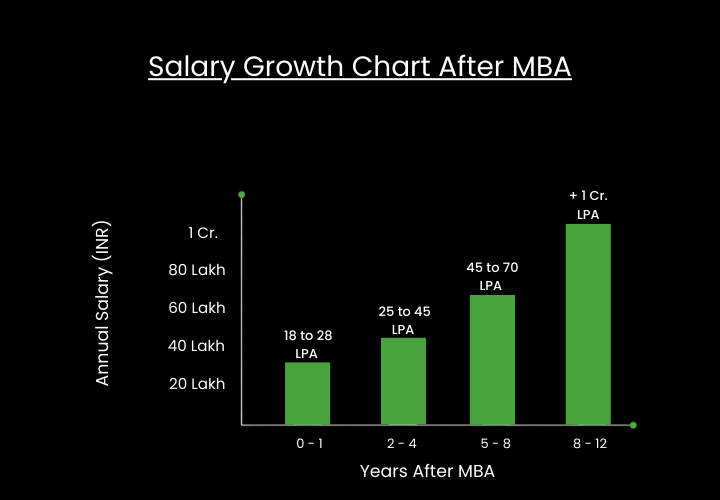
A typical progression pattern after the MBA looks like the following:
- Early stage after the MBA from year zero to year one
Professionals enter Associate product manager roles, with salaries averaging ₹18 lakh to ₹28 lakh, especially in SaaS, fintech, consumer tech and AI-led startups.
- Growth phase from year two to year four
Transition to Product Manager or Senior Product Manager roles usually brings compensation in the range of ₹25 lakh to ₹45 lakh.
- Advancement stage from year five to year eight
Movement into Lead PM or Group PM roles often fall between ₹45 lakh and ₹70 lakh, supported by senior-level benchmarks from Glassdoor.
- Senior leadership trajectory from year eight to year twelve
Director and Head of Product positions regularly cross ₹1 crore annually. Salary data from Levels.fyi and top-tier Glassdoor listings verify this trend. Across this progression, the salary curve accelerates once a professional gains ownership of metrics, customer segments and strategic product decisions.
Salary Jump for Working Professionals After an Executive MBA
The TeamLease Employment Outlook 2025 confirms that mid-career professionals transitioning into digital and product roles experience one of the highest salary jumps across all job categories. Working professionals who choose an Executive MBA in product leadership often see a significant rise in compensation soon after completion.
Average salary increase after an Executive MBA:
- Average salary increase usually falls between thirty percent and fifty five percent within the 12 months.
- LinkedIn’s 2025 internal mobility data also shows a large number of transition into product roles from engineering, data, design and program management functions, making product management as one of the top three internal transition roles for the Indian technology industry.
Since Executive MBA candidates continue earning while studying, they avoid opportunity cost. This makes their return on investment significantly faster than full time MBA formats.
ROI: Real Payback Calculation Based on 2025 Data
A realistic ROI calculation for a Product Management MBA requires three variables:
- Total MBA investment
Most programs fall between 10 lakh and 25 lakh depending on duration and format.
- Annual salary uplift after completion
Majority of professionals witness an uplift between 8 lakh and 22 lakh annually, based on 2025 PM salary benchmarks.
- Payback period
Program cost divided by annual uplift determines the real timeline.
MBA cost ÷ Annual uplift
Based on Aon’s 2025 India Salary Projection Survey, digital and product roles are among the fastest growing in terms of salary movement.
As a result, the typical payback period for a Product Management MBA falls between twelve and twenty four months. This period becomes even shorter for Executive MBA participants due to zero opportunity cost.
Industry Wise Salary Uplift After a Product Management MBA
Different industries offer different uplift levels depending on digital maturity and the significance of product roles in business growth.
- Technology and SaaS
Technology and SaaS companies continue to show the strongest uplift, usually ranging from 2.4 times to 2.9 times according to the Aon India compensation outlook for 2025.
- Fintech
Fintech follows closely, where professionals often experience an uplift between 1.9 times and 2.5 times, supported by the Razorpay Fintech Talent Report for 2025.
- Consumer Internet and E-commerce
Consumer internet and ecommerce organisations record a similarly strong rise. Salary movement in this sector generally falls between 2.1 times and 2.6 times, reflected in Naukri Hiring Trends for 2025.
- Healthcare Tech and EdTech
Healthcare technology and the EdTech space demonstrate consistent growth as well, with uplift typically ranging from 1.7 times to 2.2 times as reported in the TeamLease Sector Hiring Guide for 2025.
- IT Services and Digital Consulting
IT services and digital consulting firms show a more moderate but steady uplift, usually between 1.4 times and 1.9 times based on Deloitte India technology trends for 2025.
These ranges reflect real 2025 salary movement across India’s digital talent landscape.
What Influences Post MBA Salary Growth?
Product management salaries do not rise only because of the MBA. According to NASSCOM Digital Talent Data and LinkedIn Skills Evolution Insights for 2025, certain factors significantly influence post MBA outcomes.
- Domain background
Candidates with experience in engineering, analytics, UX, marketing, consulting or program management tend to transition faster because these functions already intersect with product thinking.
- Real product work in the portfolio
Capstone projects, live product initiatives, experimentation assignments and problem solving case studies play a strong role during hiring conversations.
- Ability to articulate product thinking
Professionals who prioritise customer insight, structured thinking and business outcome clarity, especially during interviews for mid level product roles
- Referral strength
Naukri Hiring Insights for 2025 emphasise that more than 45 percent of product management hires come through referrals. Industry connections make a real difference.
- AI readiness and data capability
Product managers with AI driven product skills, data fluency and experimentation frameworks often enter higher compensation brackets. These capabilities are viewed as essential for 2025 – 2026 hires.
Corporate Hiring and IPL Campus Engagement
The Institute of Product Leadership maintains strong engagement with industry partners through hiring days, alumni networks, live projects and corporate events.
On an average month, ten companies interact with IPL, reflecting steady industry participation.Companies that have engaged with the institute include Amazon, Oracle, Bosch, Flipkart, Accenture, Deloitte, Juspay, Tata Elxsi, EY, Kyndryl, GE Healthcare and Walmart.These companies hire for a wide range of roles such as: Product Manager, Associate Product Manager, Product Owner, Growth Product Manager, Technical Product Manager, Product Analyst, Product Designer, Data Product Manager.
Source: Institute of Product Leadership- Corporate Recruiting Partners list.
Case Studies Based on Real 2025 Salary Benchmarks
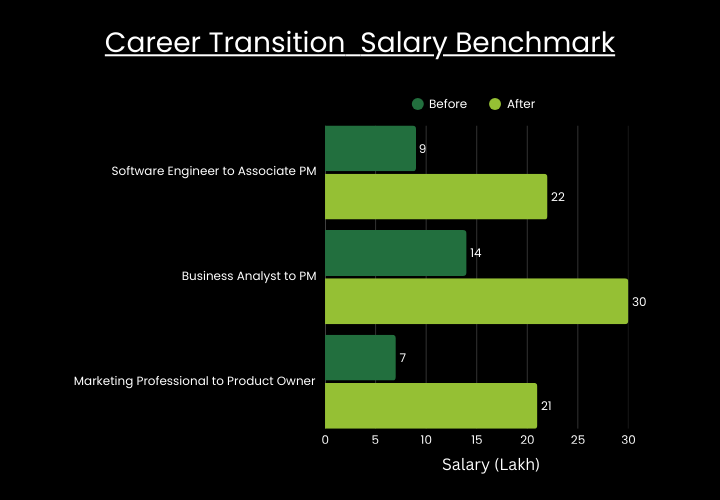
The following transitions are based on verified 2025 data and represent realistic shifts after a Product Management MBA.
Software Engineer to Associate Product Manager
Before MBA salary: nine lakh
After MBA salary: twenty two lakh
(Glassdoor APM bands)
Business Analyst to Product Manager
Before MBA salary: fourteen lakh
After MBA salary: thirty lakh
(Benchmarked using Glassdoor and AmbitionBox)
Marketing Professional to Product Owner in fintech
Before MBA salary: Seven point five lakh
After MBA salary: Twenty-one lakh
(Razorpay Fintech Talent Report 2025)
These transitions reflect realistic and well-documented 2025 pathways.
Final Takeaway
A Product Management MBA continues to deliver one of the strongest ROI profiles in India’s technology driven economy.
With salary uplifts between 1.8 times and 2.9 times, rapid early-career progression and consistent payback periods within 12 to 24 months, it remains an attractive pathway for professionals who want to build high-impact and future-proof careers.
Download the Salary Report
The complete 2025 Product Management Salary Report contains role wise salary tables, market driven benchmarks, industry uplift ranges and real compensation insights from hiring partners. Download it to review detailed numbers, trends and company level hiring information for the year: SALARY REPORT 2025
Frequently Asked Questions (FAQs)
1. What is the average Product Manager salary in India in 2025?
Most Product Managers earn between ten lakh and fifteen lakh in early roles, while mid level and senior roles move toward thirty lakh and above, depending on experience and company.
2. How does location affect Product Manager salaries in India?
Bengaluru, Mumbai and Delhi NCR usually offer the highest packages, while Hyderabad, Pune and Chennai follow with slightly lower but still competitive salaries.
3. Is a Product Management MBA a good investment for mid career professionals in India?
Mid career professionals often see strong salary growth and faster role transitions, making the MBA a valuable choice for long term product careers.
4. How long does it take to recover the cost of a Product Management MBA in India?
Most professionals recover the program cost within twelve to twenty four months due to the yearly salary uplift after graduation.
5. Which companies in India offer the highest salaries for Product Managers?
Global tech firms and leading digital first companies such as Amazon, Flipkart, Microsoft and top fintech players usually offer the strongest salary packages.
Our Popular MBA Programs