
Management has always been a coordination game. You had plans, assigned tasks, monitored progress, and made things happen. A good manager accomplished what was needed on time. That was enough.
It isn’t anymore.
Businesses now need to operate in an environment where customer needs can change in the blink of an eye, technology advances faster than any quarterly roadmap can keep up, and competitors can suddenly spring up in unexpected directions. The whole idea of the flawless execution of a fixed plan has been replaced. What organizations really need – now more than ever – are managers who can think like a product leader: those who know people and their real-world needs at a deep level, have meaningful problems to solve, and are willing to adapt continuously based on real-world results.
This is the real reason why product thinking has come to supersede product management. It is becoming an increasingly important managerial ability, for all roles, in all industries, at all levels.
It could be marketing, operations, HR, consulting, technology, business strategy – whatever it is, it doesn’t matter. All of them are becoming product-thinking savvy.
Key Takeaways
- Product thinking has evolved from PMs to a key leadership competency across functions.
- Nowadays, modern managers should be problem solvers, not mere process and team supervisors.
- In the AI age, strategic thinking, prioritization and empathy for the user is more important than mundane management duties.
- The focus is on outcome and customer impact and on ongoing improvement, for which organizations are increasingly rewarding managers.
- Managers with a product leadership mindset have a much better chance at succeeding in the future in leadership and innovation roles.
What Product Thinking Actually Means?
Product thinking is a mindset that drives the creation of products in a structured, iterative, and outcome-driven manner that addresses actual user problems.
It distracts managers from focusing on internal metrics and towards a different set of questions:
- What problem are we actually solving?
- Who are we solving it for?
- Why does this problem matter?
- Is our solution generating measurable value?
- What is the feedback telling us, and what should we change?
At its foundation, product thinking weaves together customer empathy, strategic decision-making, experimentation, and disciplined execution.
One of the reasons product companies have always been more successful than companies with a standard structure. They create organizations and teams that remain close to the user and don’t live off of hierarchies, gut feelings, or assumptions.
What is interesting is the extent to which this approach has penetrated now. The accountability is now extended to all managers, not just “product”, for things such as experience quality, adoption rates, retention, efficiency, and value creation. These are product concepts, and they have become ingrained in the expectations of every manager.
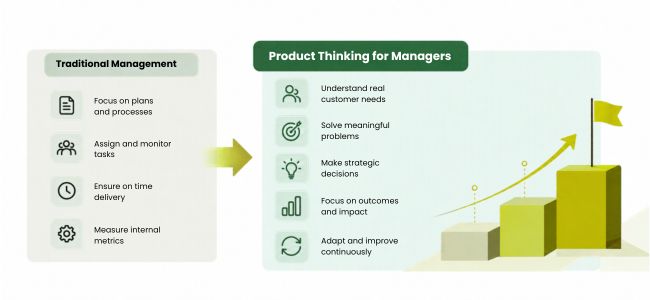
The Shift That’s Already Happening: From Process to Problem-Solving
Managing was significant about being predictable. Managers who completed projects on time, ensured continuity of processes and stability of operations were applauded. A system in which consistency is valued.
Modern business has made that model insufficient.
AI is reshaping workflows. The behaviour of customers is always changing. The concept of digital transformation is slicing through all industries, without exception. Teams have increased in cross-functionalism and have become data-driven. In this environment, fixed playbooks become liabilities.
What is needed now is managers who are able to navigate ambiguity, to discern what is important, to solve problems that are continually changing.
That demands product thinking.
A manager operating with a product mindset doesn’t just carry out instructions. They question whether the work itself is creating a meaningful impact. They represent business objectives in terms of customer outcomes. They get feedback early and make continuous improvements instead of waiting for the ‘post mortems’.
Look at how this might manifest itself:
- A marketing manager with product thinking doesn’t measure success by campaign volume alone – they focus on customer behaviour and long-term engagement.
- An HR manager thinks about employee experience the same rigorous way product teams think about user experience – mapping journeys, finding drop-off points, and iterating on solutions.
- An operations manager improves workflows by understanding the actual pain points of the people inside them, rather than simply enforcing procedures handed down from above.
- A technology manager prioritizes based on real user value rather than accommodating every stakeholder request.
This is a fundamental shift in how managers contribute and how they are evaluated.

Why Organizations Are Actively Seeking Product-Oriented Leaders
The increasingly widespread shift to outcome-based performance is one of the most obvious reasons for the growing importance of product thinking in organizations.
Many years ago, activity was what managers had to buy and sell:
- How many campaigns were sent out
- How many meetings were conducted
- How many features made it?
- How many features did they ship?
- What was the total number of hours logged?
That currency has been devalued. What organizations measure is impact:
- Did customer satisfaction move?
- Did retention improve?
- Did the initiative address a genuine pain point?
- Did the work create business value that can be pointed to?
This change goes hand-in-hand with product thinking.
When managers apply this skill over time, they make better prioritisation decisions, adjust more easily when circumstances change, work more cohesively across functions, have a more in-depth understanding of customer needs and apply data more purposefully. Critically, they build systems designed to scale rather than patches designed to hold things together temporarily.
It’s through product thinking that managers can grow their careers from coordinators to strategic problem solvers. Today, the evolution is more relevant than ever: as organizations level up their hierarchies, leaders at all levels are expected to be responsible for innovation and not just from the executive room.
AI Is Raising the Stakes for Product Thinking, Not Lowering Them
In many ways, the social skills that underpin the concepts of product thinking are more valuable than ever in the modern era of AI and not less valuable, as that technology automates many of the skills that used to belong to managers.
Automates repetitive tasks, creates reports at scale, can find patterns in data and aid in making some decisions. Several activities that formerly took a lot of time to manage are increasingly being made faster, simpler and automated.
However, AI is still limited in understanding human context, grasping emotional subtleties, determining real pain points of customers, and making strategic prioritizations.
It’s in that gap that product thinking resides.
In the era of aggressive automation, people who are truly aware of the users, who pose the right questions before proposing the answers, and who design truly valuable experiences will be very relevant.
The situation is not about replacing but amplifying. AI enhances the value of good product thinking but doesn’t substitute for it.
The reality on the ground is that:
AI can bring up ideas, but a manager must make the final call on what issues to tackle. Of course, automation is possible with AI, but it is the manager’s job to create the experiences that the processes are supposed to enable. While AI can produce output at a much faster pace than a human, it requires a manager to make sure that output meets the actual needs of the business and customers.
Those who make a career in the era of AI will nearly always be those who combine operational capability with a strong product-orientated way of thinking, rather than waiting to see what the next replacement for AI will be.
Product Thinking Creates a Common Language for Cross-Functional Leadership
Silo working models have been abandoned by modern businesses. Product & Marketing go hand in hand. Technology and business strategy go hand-in-hand. Data teams shape decisions at every level. Customer support feeds directly into product development.
With the collaboration across functions becoming the norm, an organizational-wide decision-making process must encompass both departmental and disciplinary boundaries.
Product thinking does just that.
It aligns teams around:
- What users actually need
- What business outcomes matter
- How to prioritize when everything feels urgent
- How to conduct experiments and to learn quickly.
- How to keep improving rather than declaring victory
Managers with a product mindset are better able to work across departments, as they can convey the value of each department’s part of the task in helping to deliver the overall customer result. They speak in terms that translate – not just up and down their own chain, but laterally across the organization.
In digital-first businesses, collaboration between various functions is critical, and the velocity and quality of this collaboration can directly influence the pace of innovation.
Product Thinking as a Career Accelerator
There is another aspect to why product-thinking skills are an investment for managers that goes beyond organizational impact, and it is simply that product thinking unlocks doors.
The skills and characteristics that are expected of most managers looking to become leaders in the future are becoming table-stakes: strategic thinking, adaptability and a customer-centric mindset. Professionals who understand product frameworks – how to frame problems, how to prioritize, how to measure outcomes – find it significantly easier to transition into:
- Product management
- Business strategy and corporate development
- Innovation and new ventures
- Digital transformation leadership
- Growth and analytics roles
- Senior technology management
Product thinking generates differentiation even in the traditional management tracks. It’s a clear indicator to hiring managers and executive teams that this candidate grasps how a team works and why it’s important. That is yet a growing, rare and valuable view.
Organizations want leaders who will bridge the gap between execution and impact. Managers who have a product leader’s mind always have an advantage in doing that.
The Future Is Built by Managers Who Think Like Builders
The nature of today’s work is changing from hierarchies of command and control to systems that are flexible and customer-oriented. In that world, managers are not being required to oversee work but rather to influence experiences, define and solve real problems, speed innovation and create value – measurable value.
While operational efficiency is important, it’s not enough.
What is called for now is product thinking.
Those managers who make the effort to get it right in the coming years will likely be the ones who are willing to experiment, to be curious, to show an understanding of how the user will think, and to have the foresight to know what and why to build. They will interact with teams, systems, processes, and customer experiences as builders interact with materials, with intent and craftsmanship and with vision for what they are seeking to build.
Product thinking is not just for the product expert; it is no longer a niche in the organization.
It is becoming one of the most important managerial capabilities of the era and the managers who develop it now are the ones who will lead what comes next.
Frequently Asked Questions
1. What is product thinking in management?
Product thinking in management is the discipline of solving problems by centering customer needs, business outcomes, and continuous improvement rather than focusing narrowly on internal processes and execution. It draws on strategic thinking, user empathy, experimentation, and data-driven decision-making as its core tools.
2. Why is product thinking becoming important for managers?
Because modern businesses require managers who can move quickly, drive real innovation, and create customer value that can be demonstrated. Organizations are increasingly rewarding outcome-driven leadership and moving away from traditional models that measured success by activity and compliance alone.
3. Is product thinking useful outside product management roles?
Absolutely. Product thinking adds meaningful value across marketing, operations, HR, consulting, technology, and strategy. In any function where teams interact with users, design experiences, or need to measure whether their work is actually working, product thinking is directly applicable.
4. How does AI increase the importance of product thinking?
As AI absorbs more of the repetitive work traditionally done by managers, the human capabilities that AI cannot replicate strategic prioritization, genuine customer understanding, and problem framing become more important and more differentiating. Product thinking sits exactly at this intersection.
5. How can managers develop product thinking skills?
Through a combination of customer research practice, studying user behaviour, building comfort with data analysis, applying structured problem-solving frameworks, pursuing cross-functional collaboration, and engaging seriously with product management principles, methods, and real-world case studies.
