
Why Product Managers Need Business Leadership Skills to Advance Their Careers
- Leadership, product management
- 4 min read

SaiSatish Vedam – Chief Product Officer, IPL
“Product Expertise Alone Is No Longer Enough”
For much of the last decade, product managers were evaluated primarily on their ability to build successful products.
Organizations valued professionals who could:
- Understand customer needs
- Define product requirements
- Prioritize effectively
- Align stakeholders
- Deliver outcomes
These capabilities remain important.
However, as product management has matured as a discipline, expectations have changed.
Today’s organizations increasingly expect product managers to contribute beyond product execution. They are expected to influence growth, shape strategy, evaluate opportunities, and participate in decisions that affect business performance.
This shift explains why many experienced product managers eventually discover that product expertise alone is not enough to advance into senior leadership positions.
The next stage of growth requires business leadership skills.
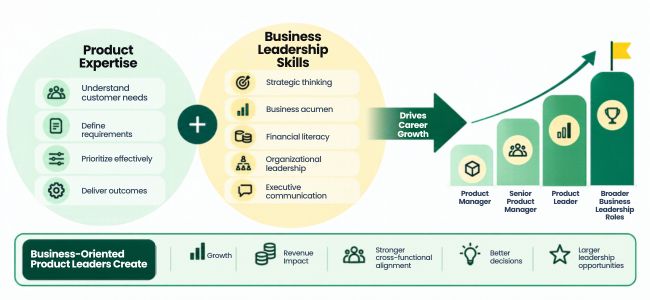
- Product expertise helps build successful products, but business leadership skills drive long-term career growth.
- Senior product managers are increasingly expected to influence strategy, growth, and business outcomes.
- Strategic thinking, financial literacy, and business acumen are essential for leadership roles.
- Understanding the difference between product success and business success is critical for career advancement.
- AI is making execution easier, increasing the importance of leadership, judgment, and decision-making skills.
- The most successful product leaders combine product thinking, business leadership, and organizational influence.
The Evolution of the Product Management Role
The Product Management function has undergone significant transformation.
Historically, product managers acted primarily as coordinators between business stakeholders and development teams. Their success depended on execution.
Today, products have become central to how organizations create value.
As a result, Product Managers increasingly participate in discussions involving:
- Market expansion
- Revenue growth
- Customer acquisition
- Competitive positioning
- Innovation investments
The role has moved closer to the center of business decision-making. This evolution creates new expectations.
Professionals are no longer evaluated solely on what they build. They are evaluated on the outcomes they help create.
Why Career Growth Slows for Many Product Managers
Many Product Managers experience strong early career growth. They learn frameworks, develop product expertise, and successfully manage increasingly complex products.
However, a common pattern emerges at the senior level:
- Career progression slows
- Promotions become less frequent
- Leadership opportunities become more competitive
- This often happens because the criteria for advancement change
Organizations begin evaluating professionals based on their ability to:
- Lead teams
- Influence strategy
- Drive business outcomes
- Manage complexity
- Align organizations
These capabilities extend beyond traditional Product Management skills.
Without business leadership development, many professionals struggle to make the transition.

The Difference Between Product Success and Business Success
One of the most important shifts in Product Leadership involves understanding the distinction between product outcomes and business outcomes.
A product can be successful from a user perspective.
It can achieve:
- Strong engagement
- High adoption
- Positive customer feedback
Yet still fail to create meaningful business impact.
Product Leaders must understand how products contribute to:
- Revenue growth
- Profitability
- Market expansion
- Customer retention
- Competitive advantage
This broader perspective requires business understanding.
The conversation changes from “Did we build the right product?” to “Did this product create business value?”
The Five Business Leadership Skills Product Managers Need
Professionals aspiring to leadership positions should focus on developing capabilities beyond product management.
Strategic Thinking
Senior leaders spend significant time making decisions under uncertainty.
They evaluate:
- Emerging opportunities
- Competitive threats
- Market shifts
- Long-term investments
Strategic thinking helps product managers move from execution to direction-setting.
Business Acumen
Product leaders must understand how organizations create and capture value.
This includes:
- Revenue models
- Unit economics
- Market dynamics
- Profitability drivers
- Growth mechanisms
Without business acumen, it becomes difficult to influence executive decisions.
Financial Literacy
Many Product Managers avoid finance. This can become a significant limitation.
Senior leaders frequently evaluate:
- Investment decisions
- Resource allocation
- Business cases
- Financial trade-offs
Understanding financial principles improves decision quality and executive credibility.
Organizational Leadership
Product Managers often influence without authority.
As responsibilities grow, professionals must learn to:
- Build alignment
- Manage conflict
- Develop teams
- Lead change initiatives
Leadership capability becomes increasingly important at higher levels.
Executive Communication
Leadership often depends on communication.
Product Leaders must communicate effectively with:
- Executives
- Investors
- Board members
- Cross-functional leaders
The ability to communicate complex ideas clearly is a critical leadership skill.
Why Product Leaders Think Like General Managers
Many successful Product Leaders eventually adopt a mindset similar to General Managers.
Rather than focusing only on products, they consider:
- Markets
- Customers
- Revenue
- Operations
- Growth
- Organizational capability
This broader perspective enables better decision-making. It also prepares professionals for larger leadership responsibilities.
In many organizations, product leadership becomes a pathway to broader business leadership roles.
Product Leadership in Product-Led Organizations
The rise of product-led organizations has increased the importance of business leadership skills.
Products now influence:
- Customer acquisition
- Activation
- Retention
- Expansion
- Advocacy
As products become growth engines, Product Leaders become growth leaders. Their decisions directly affect business performance.
This requires a deeper understanding of strategy and economics than traditional Product Management roles typically demand.
Why AI Is Increasing the Importance of Leadership Skills
Artificial intelligence is changing product development. Tasks that once required significant effort can now be automated.
Research, documentation, analysis, and even parts of product discovery are becoming more efficient. As execution becomes easier, leadership becomes more valuable.
Organizations increasingly need professionals who can:
- Make strategic decisions
- Navigate ambiguity
- Identify opportunities
- Drive organizational alignment
These are leadership capabilities. Not technical capabilities.
The AI era will likely increase demand for Product Leaders who possess strong business skills.
How Product Managers Can Build Business Leadership Skills
Developing leadership capability requires intentional effort.
Professionals can accelerate growth by increasing exposure to:
- Business strategy
- Finance
- Innovation management
- Organizational behavior
- Growth models
- Executive decision-making
Many Product Leaders also seek learning experiences that provide access to peers, mentors, and broader business perspectives.
The goal is not to become less product-focused. The goal is to understand how products contribute to larger business objectives.
The Future Belongs to Business-Oriented Product Leaders
The most successful Product Leaders of the next decade will not be defined solely by product expertise.
They will combine:
-
Product Thinking – Understanding customers and product opportunities.
-
Business Leadership – Understanding growth, strategy, and value creation.
-
Organizational Leadership – Aligning people, teams, and resources around common objectives.
Professionals who develop all three capabilities will be well-positioned for long-term career growth.
Product Management remains one of the most influential disciplines in modern organizations.
However, the path to leadership increasingly requires capabilities beyond product expertise.
As professionals progress in their careers, business leadership skills become essential for influencing strategy, driving growth, and creating organizational impact.
The Product Managers who become Product Leaders are rarely those who know the most frameworks. They are the ones who learn how products create business value.
Frequently Asked Questions
1. Why do Product Managers need business leadership skills?
Business leadership skills help Product Managers influence strategy, drive growth, manage teams, and contribute to broader organizational objectives.
2. What skills are needed for Product Leadership?
Strategic thinking, business acumen, financial literacy, organizational leadership, and executive communication are among the most important Product Leadership skills.
3. How can Product Managers become leaders?
Product Managers can become leaders by expanding their expertise beyond product execution and developing business, strategic, and leadership capabilities.
4. What is the difference between Product Management and Product Leadership?
Product Management focuses on building successful products. Product Leadership focuses on creating business value, driving growth, and influencing organizational outcomes.
5. Why is business acumen important for Product Managers?
Business acumen helps Product Managers understand how products contribute to revenue, profitability, growth, and competitive advantage.