
Product Strategy Lessons from Tesla
- Strategy
- 4 min read

Pinkesh Shah – Founder & CEO, Delightloop
“Some people do not like change, but you need to embrace change if the alternative is disaster.” – Elon Musk
For years, most automotive companies improved vehicles gradually. Better engines, updated interiors, minor design changes, and incremental technology upgrades defined competition across the industry.
Tesla changed the direction of that conversation.
The company made cars feel more like evolving technology products than traditional vehicles. Software updates became part of ownership. Charging infrastructure became strategically important. Customer expectations around vehicles started shifting much faster than the industry anticipated.
According to the International Energy Agency, global electric vehicle sales exceeded 17 million units in 2024, accounting for more than 20 percent of new car sales worldwide.
Tesla played a major role in accelerating that transition and, in the process, became one of the most important modern case studies in product strategy and innovation leadership.
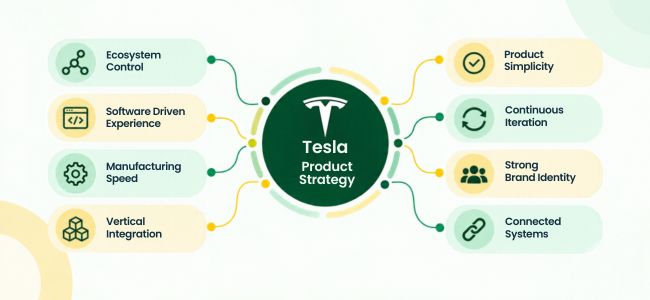
- Tesla built products around ecosystem control rather than isolated vehicles.
- Software became a central competitive advantage.
- Manufacturing speed strengthened innovation speed.
- Vertical integration improved operational control.
- Product simplicity reduced customer friction.
- Continuous iteration changed customer expectations.
- Brand identity amplified product differentiation.
- Connected systems strengthened long-term retention.
Tesla Solved More Than the Vehicle Problem
One reason Tesla succeeded where many early EV companies struggled is that the company recognized electric vehicles alone were not enough.
Consumers were not simply evaluating the car itself. They were evaluating the entire ownership experience. People worried about:
- Charging access
- Battery range
- Reliability
- Infrastructure
- Convenience
- Long-distance usability
Traditional automakers mostly focused on producing the vehicle. Tesla focused on reducing friction around adoption itself. That changed the strategy entirely.
The company invested heavily in:
- Charging infrastructure
- Battery systems
- Software integration
- Connected experiences
- Direct customer relationships
Tesla understood that customers adopt ecosystems more comfortably than isolated products. The Supercharger network became one of the strongest examples of this thinking.
According to Tesla, the company’s Supercharger network exceeded 75,000 global Superchargers in 2025. That infrastructure mattered because it reduced anxiety around EV ownership.
A product becomes easier to adopt when surrounding systems remove uncertainty. Tesla extended this ecosystem thinking into:
- Energy storage
- Solar products
- Software services
- Connected applications
The company was building a larger behavioural system around energy and transportation rather than only selling cars. That long-term ecosystem approach strengthened customer retention far beyond traditional automotive relationships.
Tesla Treated Software Like Part of the Product Experience
Traditional vehicles remained largely unchanged after purchase for decades. Tesla disrupted that expectation.
The company made vehicles feel alive in a way most consumers had never experienced before. Software updates improved features after customers already owned the car. Interfaces evolved, performance improved, capabilities expanded over time. That changed the psychology of ownership completely. The product no longer felt finished at the point of sale. It kept evolving.
According to McKinsey research, software-defined vehicles are expected to reshape automotive competition significantly over the coming years.
Tesla recognized that shift earlier than many competitors. The company integrated software deeply across:
- Navigation
- Safety systems
- Battery optimization
- Entertainment
- Diagnostics
- Driving assistance
This created advantages beyond customer convenience. Tesla gained:
- Faster iteration cycles
- Real-time product feedback
- Stronger operational visibility
- Continuous engagement opportunities
Many traditional automotive companies struggled because their organizational structures were built around slower hardware cycles.
Tesla operated more like a software company entering the automotive industry. That distinction became strategically important.
For product leaders, this highlights a major shift happening across industries. Increasingly, products are becoming dynamic systems instead of fixed releases.

Tesla Turned Manufacturing Into a Competitive Weapon
Many organizations treat manufacturing as operational infrastructure sitting behind the product. Tesla treated manufacturing itself as part of product strategy.
That mindset influenced how the company approached:
- Production systems
- Factory design
- Supply chain control
- Battery development
- Operational speed
Tesla recognized something many companies underestimate. Innovation slows down when operational coordination becomes fragmented.
The company attempted to reduce that dependency through vertical integration and tighter control over critical systems. Gigafactories became part of that strategy. They were not only manufacturing facilities. They were operational acceleration systems.
According to Tesla annual reports, the company delivered approximately 1.79 million vehicles globally in 2024.
Scaling at that level required manufacturing systems capable of adapting quickly under pressure. Tesla continuously experimented with:
- Automation
- Production flow
- Assembly design
- Battery systems
- Supply chain efficiency
This allowed the company to move faster than many competitors attempting to scale EV production through traditional automotive structures.
For product leaders, this creates an important insight. Execution systems often become part of competitive differentiation themselves.
Tesla Built a Brand Around the Future
Tesla rarely marketed itself like a traditional automotive company. The brand operated more like a technology movement. Customers were not only purchasing vehicles.
Many felt they were participating in a broader shift connected to innovation, sustainability, and technological progress. That emotional positioning mattered enormously.
Strong products become stronger when customers emotionally connect with the future the company represents.
According to Statista, Tesla consistently ranks among the world’s most valuable automotive brands. The company also generated unusually high levels of attention around:
- Launch events
- Software updates
- Technology announcements
- Product reveals
This created engagement patterns that looked closer to consumer technology companies than traditional automotive brands.
Tesla benefited heavily from community amplification as customers, investors, creators, and technology audiences discussed the company continuously online.
The brand itself became associated with innovation speed. That positioning strengthened customer loyalty beyond product specifications alone.
For product leaders, this demonstrates an important strategic pattern. Products gain stronger market momentum when they connect with identity, aspiration, and future-oriented behaviour.
Tesla Reduced Complexity Wherever Possible
One of Tesla’s less discussed advantages is simplicity. The company consistently reduced friction across the customer journey.
Traditional automotive purchasing often involved:
- Dealership negotiations
- Complicated configurations
- Fragmented service systems
- Disconnected buying experiences
Tesla simplified aggressively. The direct sales model reduced layers between customers and the company. The purchasing process became more digital and predictable The in-vehicle experience reflected similar thinking.
Tesla minimized physical controls while centralizing many interactions through software-driven interfaces. This simplicity was not only aesthetic. It reduced cognitive load for customers.
People adapt more quickly to products that feel intuitive. Tesla understood that simplicity accelerates adoption more effectively than feature overload.
Many companies underestimate how much operational complexity customers tolerate silently until they experience something easier.
Once expectations shift, older experiences begin feeling outdated very quickly.
Tesla Optimized for Speed Instead of Industry Comfort
Traditional automotive companies historically operated through long product cycles and slower organizational structures. Tesla moved differently.
The company continuously adjusted:
- Software features
- Manufacturing systems
- Interfaces
- Operational processes
- Customer experiences
This created much faster iteration cycles.
Tesla behaved more like a technology organization competing in the automotive industry. That distinction mattered because market expectations were changing quickly.
According to BloombergNEF, electric vehicle competition is expected to intensify significantly over the coming decade as adoption expands globally.
Tesla established early advantages partly because it adapted faster than many competitors around it. The company tolerated experimentation, operational risk, and iteration speed at levels many traditional automotive organizations found uncomfortable.
For product leaders, this highlights something increasingly important across industries. Execution velocity often becomes a competitive advantage when markets evolve rapidly. Organizations operating through slower coordination systems frequently struggle to adapt before customer expectations change again.
Tesla Built a System That Reinforced Itself
Tesla becomes easier to understand when viewed as a connected system instead of a vehicle manufacturer. The company linked together:
- Vehicles
- Charging infrastructure
- Software systems
- Battery technology
- Energy products
- Data collection
Each layer strengthened another layer. That created reinforcing advantages around:
- Customer retention
- Operational control
- Ecosystem familiarity
- Product differentiation
Competitors could replicate individual features. Replicating the entire ecosystem became much harder.
Tesla recognized early that modern competition increasingly happens through connected experiences rather than standalone products. That ecosystem strategy strengthened long-term defensibility in ways many competitors are still attempting to replicate.
The Bigger Product Strategy Lesson Behind Tesla
Tesla succeeded because it approached product strategy as a system rather than a sequence of isolated product decisions. The company combined:
- Ecosystem thinking
- Software integration
- Manufacturing control
- Operational speed
- Customer simplicity
- Infrastructure investment
into one connected direction. That integration became difficult to replicate because each layer reinforced the others continuously.
Tesla did not only redesign vehicles. It redesigned how vehicles interact with software, infrastructure, energy systems, manufacturing, and customer behaviour.
For product leaders, that may be the most important lesson behind Tesla’s strategy. The strongest products rarely succeed alone. They succeed because surrounding systems make adoption, retention, and evolution easier over time.
Frequently Asked Questions
1. What makes Tesla’s product strategy different?
Tesla combines software, infrastructure, manufacturing, and ecosystem thinking into one integrated strategy instead of focusing only on vehicle production.
2. Why is Tesla considered innovative?
Tesla changed how customers experience vehicles through software updates, connected systems, charging infrastructure, and vertically integrated operations.
3. How does Tesla use software as a competitive advantage?
Tesla continuously improves vehicles through over-the-air updates, software integration, connected systems, and real-time operational data.
4. Why is Tesla’s ecosystem important?
Tesla’s ecosystem connects vehicles, charging infrastructure, energy products, and software systems into one integrated customer experience.
5. What product strategy lessons can companies learn from Tesla?
Companies can learn the importance of ecosystem thinking, operational speed, software integration, customer simplicity, and long-term strategic conviction from Tesla.