
How AI Is Changing Future of Product Management in 2026
- blogs, product management
- 4 min read
Author: Akansha Chauhan – Product Marketer
Artificial intelligence is transforming nearly every profession. Software development is changing, marketing is changing, sales is changing, and customer service is changing. Product Management is no exception.
Over the last few years, AI tools have become increasingly capable of performing tasks that once consumed significant portions of a product manager’s time.
- Research can be automated
- Documentation can be generated
- Customer feedback can be analyzed
- Product requirements can be drafted
- Insights can be surfaced instantly
As a result, many professionals are asking an important question: Will AI replace Product Managers?
The short answer is no.
However, AI will fundamentally change how product managers work.
The future product manager will spend less time managing information and more time creating direction. This shift may ultimately make product management more strategic than ever before.
- AI is automating routine Product management tasks such as research, documentation, analysis, and reporting.
- The role of product managers is shifting from information processing to strategic decision-making and leadership.
- Product managers who effectively leverage AI can improve productivity, learning speed, and decision quality.
- The future belongs to AI-augmented product managers who combine customer understanding, technology awareness, and business leadership.
How Is AI Changing Product Management?
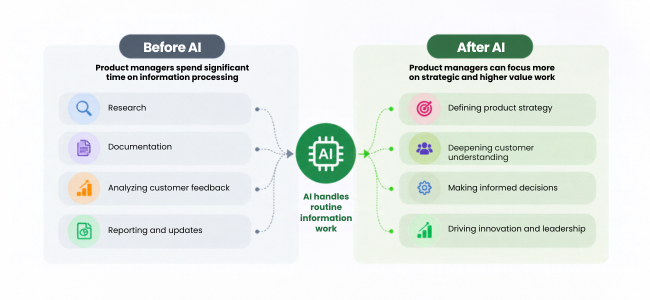
AI is automating many operational and analytical tasks traditionally performed by Product Managers, including research, documentation, analysis, and reporting. As a result, product managers are spending more time on strategic thinking, customer understanding, innovation, leadership, and business decision-making.
Product Management Before AI
Historically, product managers spent significant time gathering and processing information.
A typical week might include:
- Customer interviews
- Market research
- Competitor analysis
- Data analysis
- Writing requirements
- Creating reports
- Building presentations
Much of the work involved collecting information and transforming it into decisions. This process was often time-consuming.

Product Management After AI
AI dramatically reduces the effort required to process information. Tasks that once took days can now take minutes.
Modern AI tools can assist with:
- Customer feedback analysis
- Market research summaries
- Product requirement generation
- User story creation
- Competitive intelligence
- Data interpretation
This changes how product managers allocate their time.
The role shifts from information gathering to judgement and decision-making.
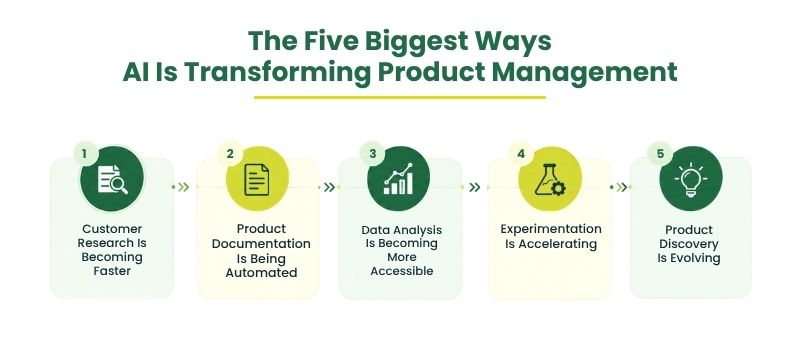
The Five Biggest Ways AI Is Transforming Product Management
1. Customer Research Is Becoming Faster
Understanding customers remains one of the most important product management responsibilities.
AI can now help analyze:
- Customer interviews
- Survey responses
- Support tickets
- Reviews
- Community discussions
Instead of manually reviewing thousands of data points, product managers can identify patterns more quickly.
This increases efficiency.
However, customer empathy still requires human understanding. AI can identify signals. Product managers must interpret meaning.
2. Product Documentation Is Being Automated
Many Product Managers spend significant time creating:
- Product requirements
- User stories
- Acceptance criteria
- Product briefs
AI tools increasingly assist with these tasks.
Documentation that once required hours can often be generated within minutes.
This does not eliminate the need for product managers. It allows them to focus on higher-value work.
3. Data Analysis Is Becoming More Accessible
Data has always been central to product management. The challenge has often been interpretation.
AI tools now help professionals:
- Identify trends
- Surface anomalies
- Analyze behavior patterns
- Generate insights
As analytical barriers decrease, decision quality becomes more important than access to information.
4. Experimentation Is Accelerating
Product teams increasingly use AI to:
- Generate hypotheses
- Analyze experiments
- Predict outcomes
- Identify optimization opportunities
This accelerates product learning cycles.
Organizations can evaluate ideas faster than before.
5. Product Discovery Is Evolving
Product discovery traditionally involved significant manual effort.
AI now helps identify:
- Customer pain points
- Market opportunities
- Emerging trends
- Competitive shifts
This does not replace discovery.
It enhances it. The best Product Managers combine AI-generated insights with human judgement.
What AI Cannot Replace?
While AI is becoming increasingly capable, several product management responsibilities remain deeply human.
Strategic Decision-Making
AI can provide information. It cannot fully determine organizational priorities.
Some questions require leadership judgement, such as:
- Which opportunity deserves investment?
- Which market should we enter?
- Which risks should we accept?
Customer Empathy
AI can analyze customer behaviour. Understanding human motivations remains different.
The ability to understand why customers behave the way they do continues to be valuable.
Stakeholder Alignment
Product Managers spend significant time aligning:
- Executives
- Engineers
- Designers
- Sales teams
- Customers
Organizational alignment remains a human challenge. AI cannot replace influence.
Leadership
As Product Managers advance, leadership becomes increasingly important.
Leadership involves:
- Trust
- Communication
- Motivation
- Vision
These capabilities remain difficult to automate.
Innovation
AI can generate ideas. Determining which ideas matter remains a human responsibility.
Innovation often emerges from understanding context, timing, and opportunity.
The Rise of the AI-Augmented Product Manager
The future is unlikely to be AI versus product managers. The future is more likely to be AI-augmented product managers.
Professionals who effectively leverage AI will gain advantages in:
- Speed
- Productivity
- Decision-making
- Learning
The role becomes more powerful rather than less relevant.
How Product Manager Skills Are Changing?
As AI automates routine activities, the importance of certain skills increases.
- Strategic Thinking – Understanding long-term opportunities becomes more valuable.
- Business Acumen – Connecting product decisions to business outcomes becomes critical.
- Leadership – Influencing teams and organizations remains essential.
- Systems Thinking – Understanding how multiple factors interact becomes increasingly important.
- AI Fluency – Product Managers do not need to become AI engineers.
However, they increasingly need to understand:
- AI capabilities
- AI limitations
- AI business models
- AI product opportunities
This knowledge is becoming a competitive advantage.
Product Managers vs AI: The Wrong Question
Many professionals ask: Will AI replace Product Managers?
A better question is: Which Product Managers will thrive in an AI-driven world?
The answer is often clear.
The Product Managers who:
- Think strategically
- Understand customers deeply
- Lead effectively
- Make sound decisions
- Understand business dynamics
will remain highly valuable.
AI changes how work is performed. It does not eliminate the need for leadership.
Why Product Leadership Becomes More Important?
One of the most significant effects of AI is that it elevates the importance of Product Leadership.
As execution becomes easier:
- Prioritization matters more.
- Strategy matters more.
- Judgement matters more.
- Growth decisions matter more.
Organizations increasingly need leaders who can determine where to invest, which opportunities matter, and how products create competitive advantage.
These are product leadership responsibilities.
The Future Product Manager
The next generation of product managers will likely spend less time producing outputs and more time creating outcomes.
Success will increasingly depend on the ability to combine:
- Customer Understanding – Understanding unmet needs.
- Technology Awareness – Leveraging emerging capabilities.
- Business Leadership – Driving growth and organizational success.
This combination defines the future of product management.
Artificial intelligence is transforming product management. Many routine tasks are becoming faster, easier, and more automated.
However, the core responsibilities of product managers remain deeply human. Organizations still need professionals who can understand customers, make decisions, align teams, and create business value.
In many ways, AI is elevating product management rather than replacing it.
The future belongs to product managers who embrace AI while strengthening the strategic, leadership, and business capabilities that technology cannot easily replicate. The role is evolving. Its importance is not diminishing.
Frequently Asked Questions
1. How is AI changing Product Management?
AI is automating research, analysis, documentation, and reporting, allowing product managers to focus more on strategy, leadership, and decision-making.
2. Will AI replace Product Managers?
No. While AI can automate many tasks, product managers remain responsible for strategy, customer understanding, prioritization, innovation, and leadership.
3. What Product Management skills will become more important because of AI?
Strategic thinking, business acumen, leadership, customer empathy, systems thinking, and AI fluency are becoming increasingly important.
4. Do Product Managers need to learn AI?
Yes. Product managers should understand AI capabilities, limitations, use cases, and business implications to remain effective in modern product organizations.
5. What is an AI-augmented Product Manager?
An AI-augmented product manager uses AI tools to improve productivity, accelerate learning, and support decision-making while focusing on higher-value strategic work.