Understanding Consumer Psychology: From the Lens of a Product Manager
- product management
- 4 min read

Ritesh Jain – Director of Product Managemnt, Samsung Electronics
A lot of product work looks clean on paper. You map the flow, reduce steps, tighten the copy, polish the UI, and ship something that feels genuinely useful. Then the numbers come in and you’re staring at the same question every product team has asked at least once:
“Why are people not doing the thing?”
They don’t sign up. They don’t install. They don’t finish onboarding. They don’t try the feature you were sure would land. And what makes it more confusing is that nobody is angry. Users rarely complain. They simply… disappear.
This is where consumer psychology stops being a “nice-to-know” and becomes a build tool. Because users don’t make decisions in a clean, rational sequence. They make them in a noisy head, with distractions, memories, doubts, and small fears that show up at the exact moment you need momentum.
This blog breaks down how that noise works, how it shows up in product decisions, and what you can do about it.
- Users don’t drop because the product is bad; they drop because the next step feels unclear or unsafe.
- The goal isn’t to explain harder; it’s to remove ambiguity so action feels obvious.
- The curse of knowledge breaks “standard” flows, so test by watching users without guiding them.
- Strong products come from chasing the why behind behaviour, not just tracking what happened in the funnel.
- Replace “Would you use this?” with pain-first questions and design a star moment users will remember.
The simple decision that turns into a mental traffic jam
From a product lens, some actions feel trivial:
- Fill a signup form
- Tap “Install”
- Grant permission.
- Try a new feature
But in a real brain, that moment is rarely empty. It’s full.
A user sees your signup screen and starts doing a silent risk calculation. Not because they’re paranoid. Because the internet trained them to be cautious.
They might not say these thoughts out loud, but they’ll feel them:
- “Will this spam me later?”
- “Why are they asking for this?”
- “Is this going to be one more thing I regret downloading?”
- “What if I don’t understand it and waste time?”
These doubts can appear in seconds, and they don’t need to be rational to be powerful. Most drop-offs happen because the decision feels unclear or unsafe, not because the user is incapable of understanding.
That’s why the goal isn’t “explain harder”. The goal is to remove ambiguity so the next step feels safe and obvious.

Don’t make people think. Make the value feel intuitive.
There’s a quiet difference between a product that is valuable and a product that feels valuable at the moment of decision.
Teams often assume that if value is present, users will push through. In reality, the moment a user has to pause and decode, you’ve created friction. And friction doesn’t always show up as complaints. It usually shows up as silence.
A practical way to spot this is to look for “hesitation moments” in your product:
- users reread the same line twice
- users click something that looks like the action, but isn’t
- users abandon and return later, then abandon again
- support questions that start with “I don’t see…” or “Where do I…”
Those aren’t minor UX issues. They’re decision blockers. They’re signs your product is asking users to do cognitive work when they have no motivation to do it.
A simple product principle worth repeating: make it intuitive enough that users don’t need to negotiate with themselves.
The curse of knowledge: why “obvious” breaks in the real world
Product teams live inside their own context. Users don’t.
That gap creates one of the most common product failures: you assume people know what you know. It feels “standard”. It feels “basic”. It feels like something no one would misunderstand. And then someone does.
A small example illustrates this perfectly. Imagine trying to help a parent install a medical teleconsultation app remotely. You guide them to the app page and tell them to hit download. They say, “Nothing is happening.”
You ask what they’re clicking. They reply, “I’m clicking on ‘5 million downloads’.”
From their side, it looks like the action. From your side, it’s clearly a metric. To you, this is almost funny. To them, it’s frustrating.
It gets worse: users often blame themselves first. They don’t say, “This interface is unclear.” They say, “I’m not good at this.” Once that feeling shows up, they avoid trying again.
This is why the best kind of product testing is uncomfortable. You don’t guide. You don’t explain. You watch. Confusion is not user failure. Confusion is product feedback.
If you do any internal testing or “dogfooding”, try one rule: give zero instructions and observe. The places people hesitate will teach you more than a dozen surveys.
The best insights come from “why”, not “what”
Data and research are excellent at telling you what happened: drop-offs, usage, retention curves, and funnels. You can build decent products with that.
But the leap from decent to enduring comes from the why.
- Why did they hesitate here?
- Why did they choose this workaround?
- Why does one feature become a habit while another is ignored?
- Why do they say one thing in interviews and do another in real life?
The “why” often leads you away from surface features and toward deeper human needs. A helpful way to keep this grounded is to pressure-test your insights against a simple truth: products that survive over time typically improve life in ways people can feel.
- They reduce anxiety or effort.
- They increase control or safety.
- They make users feel competent.
- They help users feel connected or understood.
- They save time in a way that feels meaningful.
Technology is the delivery. The real job is to make someone’s day slightly better in a way they can sense quickly.
Ask for pain, not approval
There’s a question teams love because it feels direct:
“Would you use this product?”
It’s also a weak signal. People say yes for all kinds of reasons – politeness, curiosity, optimism – without truly knowing what it will feel like in real life.
Better questions aim at friction, not validation:
- “What part of this is annoying today?”
- “When was the last time this went wrong?”
- “What do you do when you’re rushed?”
- “What do you wish happened automatically?”
When you ask like this, you don’t just hear feature requests. You hear the underlying pain people have learnt to tolerate. That’s where strong product ideas are hiding.
There’s also a subtle mental shift here: instead of inviting people to judge your idea, you invite them to describe their reality. That makes their answers more honest and more useful.
How unmet needs show up in real life?
A quick way to spot psychology at work is to look for moments where users don’t ask for a solution but still struggle.
Decision fatigue while capturing moments
At birthdays or performances, people spend precious seconds deciding: photo or video, wide lens, mode, framing. While they’re choosing, the moment is gone. The real problem isn’t camera quality. It’s decision fatigue under time pressure.
A smarter approach reduces the decision-making burden. Give users one action that captures multiple outputs, then let them choose later. The human value isn’t “AI features”. It’s relief. It’s being present without missing the moment.
Confusion during onboarding
The same pattern shows up in install and onboarding flows. When users can’t immediately find the next step because the action isn’t obvious, the label is unclear, or the flow hides what’s happening, they rarely fight through it. They just leave.
The lesson is consistent: where clarity drops, adoption drops.
Prioritization: make tradeoffs with a psychological lens
Even if you understand psychology, you still face a hard truth: you can’t build everything. Users will ask for ten things. You’ll have time for two.
A practical way to prioritize is to ensure your roadmap includes three kinds of outcomes:
- Acquisition: what brings new users in
- Engagement and retention: what keeps them coming back
- Growth: monetization or the business outcome you’re responsible for
Then evaluate each request with a mix of factors:
- How much user delight it creates
- Which outcome bucket it supports (acquisition, retention, growth)
- Alignment with business goals
- Implementation effort and timelines
What matters is not the maths itself, but the discipline: prioritizing based on user impact and feasibility rather than loudness or internal bias.
Know when you’re improving the product and when you’re stuck in a spiral
When something isn’t working, the default reaction is to add more.
Add a feature. Add a setting. Add more onboarding. Add more explanations.
Sometimes that helps. Often, it creates a brief lift, and then the product stagnates again. Then you add again. That’s the product spiral: motion without clarity.
The way out is a reset question:
What unmet need does this product solve today, and is it still meaningful?
If the answer has drifted away from something human, tweaks won’t save it. You either reconnect with the real need, or you pivot toward a problem you can solve better.
Pivoting isn’t dramatic. It’s disciplined. It’s choosing not to spend years polishing something that no longer has a strong reason to exist.
Build a “star moment” users will remember
People forget most onboarding. They forget most pitches. They even forget why they downloaded you.
But they remember a moment.
A small experience that makes them feel something – surprise, delight, relief, or confidence. Something that creates a story in their head: “This product gets it.”
That’s the “star moment”. It doesn’t need to be flashy. It needs to be memorable.
If the first real experience is bland or confusing, users don’t stay long enough to discover deeper value later. So it’s worth asking:
What will they remember after the first real interaction?
If the answer is “nothing”, retention becomes harder than it needs to be.
A practical checklist for building with consumer psychology
If you want to apply all of this without turning it into theory, here’s a simple working checklist:
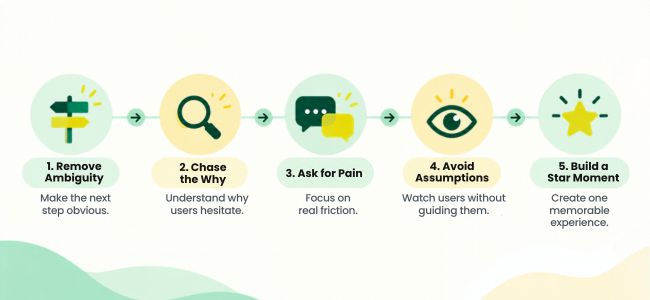
- Where does the user hesitate? Watch sessions, support tickets, and second-guess clicks.
- What ambiguity can you remove? Replace clever labels with obvious ones. Reduce interpretation.
- What’s the hidden doubt? Anticipate fears around spam, privacy, effort, or regret. Address them early.
- Are you assuming knowledge? Test with zero instructions and observe confusion.
- Are you asking for pain or approval? Rewrite discovery questions to focus on real friction.
- What’s the star moment? Design one memorable win early, so users feel the product’s point quickly.
The most important product surface isn’t your UI. It’s the human mind interacting with it.
If the next step feels unclear, users don’t debate. They retreat. If it feels intuitive and safe, they move.
Remove ambiguity. Don’t assume knowledge. Chase the why. Ask for pain, not approval. Build one moment worth remembering.
That’s how you stop building features and start building behaviour.
Frequently Asked Questions
1. Why do users drop off during sign-up or onboarding?
Usually because the next step feels unclear, slow, or not worth the effort confusing UX and delayed access are common killers.
2. How do you reduce onboarding friction quickly?
Remove ambiguity (labels, CTAs, permissions), shorten time-to-value, and guide users to one clear first win instead of explaining everything upfront.
3. What is the “curse of knowledge” in UX/product design?
It’s a cognitive bias where experts assume users know what they know, so “obvious” flows break for beginners.
4. How do you identify unmet customer needs (beyond feature requests)?
Use interviews plus the “Five Whys” to move from what users say they want to the underlying reason and friction they’re actually trying to solve.
5. How do you know whether to pivot or keep iterating on a product?
If you’re stuck adding features without improving adoption, reset to the core unmet need and whether it still matters; if not, a pivot is often more disciplined than endless tweaks.
Our Popular Product Management Programs