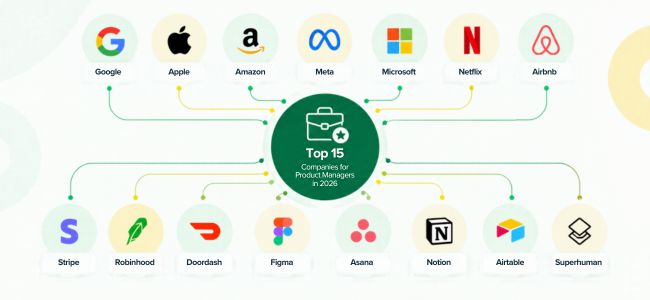

What Makes Google a Dream Company for Product Managers?

Back in 2004, a then-unknown product manager joined Google to work on a side project called “AdSense for content.” It wasn’t glamorous. It wasn’t even fully formed. But over the next few years, that product scaled into one of the company’s biggest revenue streams, contributing billions to Google’s bottom line.

That product manager at Google? Susan Wojcicki, who later became the CEO of YouTube.

It is the stories such as these that have helped Google become more than a tech giant. It is now become a dream job place particularly among product managers. So why then is Google such an attraction for PM talent? Why do some of the smartest, most ambitious product minds flock to the big G, not to receive the badge, but to remain, develop and lead iconic products, used by billions?

Let’s break it down. 

In this article
    Add a header to begin generating the table of contents

    The Scale is Mind-Bending

    Google doesn’t build for a niche. It builds for the world. This is the playground of your dreams in case you are a Google product manager and thrive best on impact.

    • Billions of users – Chrome, Gmail, YouTube, Android… you’re solving problems for a user base that cuts across countries, cultures, and capabilities.
    • Real-time feedback – In this scale, even the smallest percentage of improvement makes a difference to millions. The immediate effects of the decisions made by product managers at Google are realised.
    • Global responsibility – From language localization to accessibility, PMs at Google not only make products work, they make them work everywhere.

    If you have ever felt like reaching more people with your decision than the population of at least a few countries, this is the place.

    Ownership Meets Autonomy

    There are no endless layers of bureaucracy in Google, as some might think. Actually, product managers at Google tend to say that they are mini-CEOs of their product lines.

    Here’s what that really means:

    • PMs call the shots – It could be a decision that prioritizes the roadmap, or it could be a move to delay engineering schedules; the PM is not merely a notepad. They lead.
    • Liberty in implementation – PMs can implement at will as soon as a vision is aligned in the manner they find appropriate to the market, their team and their users.
    • Cross-functional trust – At Google, it’s not uncommon for PMs to challenge engineering leads, UX heads, or even VPs, and be heard.

    This isn’t the kind of place where you only manage backlog tickets. You build strategy and ship at scale.

    Culture of Thoughtful Innovation

    Google does not pursue the next bright thing just to have it. It is not about winning the race, it is doing it right.

    Such an attitude works well in product work:

    • Strong user empathy – Google product managers are urged to be obsessed with actual user challenges, and then develop solutions.
    • Rigorous data thinking – Each idea is tried, supported by data, and confirmed through controlled experiments (Google essentially invented A/B testing at scale).
    • Innovation, not invention – Many of the greatest Google products were not first-to-market; they got to be the best by being refined over time via structured innovation.

    Even internal tools are put through such conscientious questioning. It is not about anything being trendy; rather, it is about doing what is right.

    Access to Legendary Talent

    The elephant in the room that should not be overlooked is that you become better working with world-class engineers, designers, and researchers.

    • Top 1% talent – A Google product manager does not work in silos. They are collaborating with AI pioneers, former founders, PhD graduates, and award-winning designers.
    • Learning never stops – Internal discussions, inter-departmental brainstorms -The exposure is out of this world.
    • You’re surrounded by craft – Be it UI polish or system design, you get continually pressed to think bigger and better.

    Such environment does not merely take your product thinking up. It reinvents the meaning of quality.

    Career Growth Without a Ceiling

    Google isn’t a revolving door for PMs. Many join and stick around for years — not out of comfort, but out of continuous growth.

    • Clear tracks for ICs and leaders – Both the paths- either leading others or remaining as a powerful individual contributor are valued and fostered.
    • Mobility across products – Would you like to exit Google Maps and go to Pixel hardware? Or from ads to AI research? A Google product manager does not just make internal moves possible, but welcomes them.
    • Manager support systems – Career conversations are structured. Managers are trained to help PMs grow, not hoard them.

    It is among the only places where you can re-invent yourself without leaving the company.

    The Product Manager Role Is Deeply Respected

    In contrast to a situation in other companies where PMs are represented as project coordinators or productized middle managers, at Google, the PM job is the key to product success.

    • PMs shape the ‘what’ and ‘why’ – Engineers turn to PMs to guide them, UX to PMs to provide balance in the scope, and the leadership expects PMs to be vision drivers.
    • Strong product culture – all of Google speaks product, from marketing to customer success.
    • Expectation of strategic clarity – PMs are not cogs in a machine. They are strategic partners.

    This degree of respect does not simply make work easier. It makes it meaningful.

    Tools, Resources, and Data Like No Other

    Let’s be real – PMs are only as good as their visibility into what’s working and what’s not. And a product manager at Google is armed like few other professionals can be.

    • Best-in-class internal tools – From experimentation platforms to bug trackers, everything is designed for speed and accuracy.


    • Data at your fingertips – PMs don’t need to chase down dashboards or wait on analysts. Self-serve data tools are deeply integrated.


    • AI-first thinking – Google is pioneering how PMs leverage AI not just in the product but also for product management from user insights to feature prioritization.


    This level of product intelligence makes decision-making faster, sharper, and more confident.

    Mission That Actually Matters

    This may sound cliché, but it’s worth saying: Google’s mission – “to organize the world’s information and make it universally accessible and useful” attracts PMs who care.

    • It’s not just ads – Yes, ads pay the bills. But product managers at Google also work on education, health, sustainability, and accessibility.


    • Impact that’s tangible – From earthquake alerts to AI-powered reading tools, PMs see the real-world effects of their work.


    • Ethical rigor – While not perfect, Google invests heavily in responsible AI, user privacy, and product fairness values that PMs genuinely believe in.

    If you want your work to matter beyond OKRs, this place gives you that shot.

    It Still Feels Like a Product Company

    Despite its size, Google hasn’t forgotten what made it great: product obsession.

    • Founders’ DNA – Even today, you’ll find echoes of Larry and Sergey’s philosophy in how decisions are made.


    • Betting on the long game – From Waymo to DeepMind, Google bets big and bets long a rarity in today’s quarterly-results-driven world.


    • PMs still prototype – You’re not just writing PRDs. You’re building early mockups, testing hypotheses, and driving MVPs.

    That scrappiness, blended with scale, is rare. And it’s part of why so many PMs not only join but stay.

    Product management is hard. The role demands clarity in chaos, alignment across teams, and empathy at scale. And while no company is perfect, Google offers PMs a unique mix of scale, culture, autonomy, and meaning.

    It’s not just the name. It’s the system. The support. The challenge.

    The reason why a google product manager chooses this path isn’t because it’s easy—it’s because it’s worth it.

    Facebook
    Twitter
    LinkedIn