
How Technology Is Reshaping Business Leadership
- Strategy
- 4 min read

Pinkesh Shah – Founder & CEO, Delightloop
Every leadership generation likes to believe its challenges are uniquely difficult.
This one might actually have a case.
A business leader today is expected to understand growth, customers, talent, operations, competition, and financial performance, which is fair enough. What has changed is the layer sitting underneath all of it. Technology is no longer a separate discussion that can be delegated and revisited later. It is tangled into the day-to-day reality of running a business.
A pricing decision may depend on analytics infrastructure. A customer retention problem might actually be a product experience issue. Hiring plans could be shaped by automation. A supply chain bottleneck may be solved through better systems, not more manpower.
This changes the job.
Leadership now demands a different kind of awareness, and companies are noticing.
- Technology is no longer confined to the back office; it’s in the centre of business strategy.
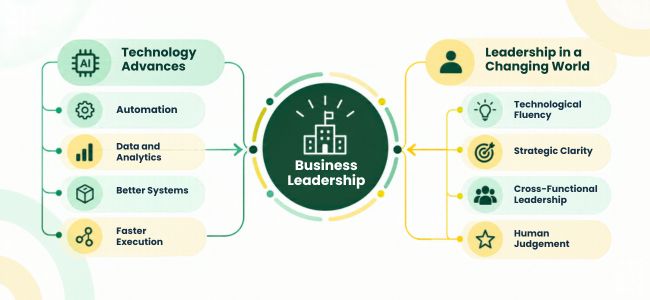
- Modern leaders don’t need to be able to write code; they need technological fluency – an ability to ask questions and to evaluate, to consider options.
- The value of human judgement, strategic clarity, and effective prioritization only grows with the automation of execution-oriented tasks, as AI becomes a more integral part of the process.
- Cross-functional leadership has become essential because technology-driven decisions impact every department.
- Those leaders who are the first to take it in and adapt to the technology-driven transformation will be the ones who will stay relevant, competitive and difficult to replace.
In Short:
Technology is reshaping business leadership by changing how organizations compete, innovate, and make decisions. Modern business leaders need digital literacy, AI understanding, product thinking, and data-driven decision-making to lead organizations effectively, adapt to rapid technological change, and deliver long-term business growth.
Business Leaders Can No Longer Stay Technologically Detached
Plenty of capable leaders built successful careers without needing to think deeply about technology. That path is narrowing.
This is not about turning every executive into a technical expert. Nobody is expecting a CEO to sit and write code between board meetings. But complete detachment is becoming a liability.
When a company wants to improve customer experience, the answer often involves platforms, integrations, product decisions, or automation. When margins are under pressure, efficiency conversations quickly become technology conversations. Even expansion plans increasingly depend on digital capability.
A leader who treats technology as somebody else’s department risks missing the bigger picture.
The stronger leaders tend to be the ones who stay curious enough to ask useful questions.
What exactly does this tool solve?
How expensive is implementation beyond the vendor pitch?
Will teams actually use it?
Does this improve the customer experience or simply create another internal dashboard?
Those questions matter more than surface-level enthusiasm.
Data Has Made Leadership Both Easier and More Complicated
One strange thing about modern leadership is that leaders have more information than ever, and yet decision-making often feels messier.
Businesses can track almost everything now.
Sales movement, churn, conversion, delivery timelines, user behaviour, engagement patterns, and customer complaints. The visibility is incredible.
But abundance creates its own problems.
Some teams confuse reporting with understanding. A dashboard full of charts can create the illusion of control while hiding the real issue.
Good leaders learn to ignore noise.
That sounds simple until you are sitting in a meeting where fifteen metrics are flashing red and every department insists its problem is the urgent one.
Technology has improved access to information. It has not made judgement obsolete.
In some ways, judgement matters more because bad interpretation now happens at greater speed.

AI Has Shifted the Conversation Entirely
AI changed the tone of leadership conversations almost overnight.
The early discussions were predictable. Excitement, fear, exaggerated claims, panic about job losses.
Now the conversation is more practical.
Where can AI save time?
Which workflows can improve?
What decisions can be supported better?
Where are the risks?
That is a healthier place to be.
Still, AI has introduced an uncomfortable question for many leaders.
If software can summarize information, generate options, analyze patterns, and reduce manual effort, where does leadership create value?
The answer is usually in the messy parts:
- Context
- Trade-offs
- Timing
- People management
- Strategic judgement
Technology is excellent at processing information. Business leadership still depends heavily on interpreting situations that are not clean, predictable, or fully measurable.
That remains human work.
Leadership Is Becoming Less Functional and More Integrative
The old model of leadership often rewarded deep specialization.
Finance leaders focused on finance.
Operations leaders focused on execution.
Marketing leaders focused on acquisition and brand.
That structure still exists, but major business initiatives now spill across departments too easily for narrow thinking to work.
A digital product rollout can affect customer support, legal, compliance, sales, operations, and engineering all at once.
Automation changes workflows beyond the team that requested it.
Technology tends to expose how interconnected businesses actually are.
This is why leaders who can bridge conversations are increasingly valuable.
Not because they know every detail.
Because they reduce friction.
They can sit in a room with technical teams and business teams without either side feeling like translation is impossible.
That is becoming a serious competitive advantage.
Customers Changed Faster Than Internal Systems Did
One of the biggest pressures on business leadership comes from customer expectations.
Customers have become used to smooth digital experiences, quick responses, personalization, and convenience. Once that becomes normal somewhere, people begin expecting it everywhere.
That creates problems for slower organizations.
A customer comparing banking apps is not thinking about legacy infrastructure.
A patient frustrated by slow hospital communication is not interested in internal workflow constraints.
People compare experiences, not operational excuses.
Leadership teams increasingly have to respond to this mismatch.
Sometimes the issue is technology investment.
Sometimes it is poor execution.
Sometimes it is simply resistance to changing how things have always been done.
Either way, leadership owns the response.
Speed Matters More Than It Used To
Business has become less forgiving of slow movement.
Opportunities move quickly. Customer sentiment shifts quickly. Competitors respond quickly.
Long approval chains and endless alignment meetings often create their own kind of risk.
This does not mean leaders should chase speed for the sake of appearing decisive.
It means organizations need leaders who understand when faster experimentation is smarter than prolonged debate.
That is a mindset shift as much as an operational one.
Technology is not changing one aspect of business leadership. It is changing the shape of the role itself.
The strongest leaders will not necessarily be the ones with the most technical knowledge.
They will be the ones who stay adaptable, ask sharper questions, understand how technology affects business choices, and avoid the trap of leading with outdated assumptions.
That is becoming the real dividing line.
Frequently Asked Questions
1. Why is technology important for business leadership today?
Technology is now becoming integral to every aspect of a business from customer experience to running day-to-day operations to growth and decision-making. Leaders who understand its impact can make faster, smarter, and more future-ready business decisions.
2. Is it necessary for business leaders to have practical technical skills if they want to succeed?
Not necessarily. Being able to ask good questions, understand what can be done and make an informed decision about strategy is the requirement; writing code or architecting systems is not.
3. How is AI specifically impacting the nature of leadership?
It is dealing with regular analysis, boosting team productivity and speeding up the time to decision. What this parallels is the increasing recognition of the importance of human judgement, prioritization, and strategic thinking – not less of it, but more.
4. In a technologically driven environment, what leadership skills are the most important?
Being adaptable, data literate, cross-functional, making effective choices in a world of uncertainty and ensuring that teams are led through change without slowing down or following a standard timeline.
5. How can technology, in practice, enhance the quality of a business decision?
It provides real-time data, customer behaviour patterns, and operational visibility in front of leaders, making it meaningfully easier to detect trends early, bring problems to the surface before they get worse, and react quickly and accurately to changing trends.