Should I Pursue an Executive MBA?
- 4 min read

Akansha Chauhan – Product Manager
If you are asking whether you should pursue an Executive MBA, you are probably evaluating more than a degree. You are considering whether this is the right investment of your time, effort, and resources at this stage of your career.
There is no single answer that applies to everyone. An Executive MBA may be the right choice for one professional and the wrong choice for another, even if both have similar experience or work in the same industry.
The decision becomes clearer when you evaluate your career goals, current responsibilities, learning objectives, and readiness to commit to a demanding program. This blog explores the questions that matter most before making that decision.
Why Professionals Start Thinking About an Executive MBA
Most professionals do not begin searching for an Executive MBA simply because they want another qualification. The decision is usually influenced by changes in their careers.
Sometimes those changes happen gradually. In other cases, they are triggered by a promotion, a new role, or increasing business responsibilities.
Although every career is different, professionals often begin exploring an Executive MBA when they experience one or more of the following situations.
Career Situation | Why It Leads Professionals to Explore an Executive MBA |
Expanding responsibilities | Day-to-day work increasingly involves business decisions rather than only functional expertise. |
Leadership opportunities | Managing people, projects, or business units requires broader management capabilities. |
Moving into a different function or industry often requires a wider understanding of business. | |
Professional growth | Learning becomes important to remain effective in a changing business environment. |
Long-term career planning | Professionals begin preparing for responsibilities they expect to take on over the next several years. |
These situations do not automatically mean an Executive MBA is the right next step.
They simply explain why many professionals begin evaluating whether executive education aligns with their future career direction.
- The decision to pursue an Executive MBA should begin with your career goals rather than the qualification itself.
- Professionals consider an Executive MBA for different reasons, including leadership development, broader business knowledge, and continuous learning.
- The ability to apply classroom learning in the workplace can enhance the overall learning experience.
- Choosing the right time depends on your professional responsibilities, personal commitments, and long-term aspirations.
- An informed decision comes from evaluating your objectives, readiness, and the suitability of the program, rather than following industry trends or external expectations.
Before You Decide, Be Clear About What You Want to Achieve
The question “Should I pursue an Executive MBA?” is often answered too quickly.
A more useful starting point is another question: “Why am I considering it?”
Your answer influences almost every other part of the decision.
For example, someone preparing for senior leadership may evaluate an Executive MBA differently from someone planning to launch a business or transition into a new function.
Before comparing institutions or curricula, take a moment to define your own objective.
Ask yourself:
- What do I want my career to look like in the next five to ten years?
- Which responsibilities am I preparing for?
- What knowledge or capabilities do I feel I need today?
- Am I looking for a qualification, broader business understanding, or leadership development?
- Will I have opportunities to apply what I learn?
There are no right or wrong answers.
However, professionals who are clear about their goals often find it easier to determine whether an Executive MBA aligns with those ambitions.
An Executive MBA Solves Different Problems for Different Professionals
One reason this decision feels difficult is that professionals rarely pursue an Executive MBA for the same reason.
Some are preparing for leadership positions. Others want to broaden their understanding of business beyond a specialised role.
Some are planning a career transition, while others simply want to continue learning in a structured environment.
The table below illustrates how motivations can differ.
Professional Objective | How an Executive MBA May Support That Goal |
Preparing for leadership | Develop broader management and strategic thinking capabilities. |
Building business knowledge | Gain exposure to finance, marketing, operations, strategy, and organisational leadership. |
Career transition | Develop transferable management knowledge that can support broader responsibilities. |
Build a stronger understanding of business planning, decision-making, and organisational management. | |
Continuous professional development | Continue learning while balancing professional responsibilities. |
The important point is not that an Executive MBA guarantees these outcomes.
Rather, it provides a structured environment where professionals can develop the knowledge and capabilities that support these objectives.
The Decision Is About Alignment, Not Eligibility

Many professionals spend considerable time asking whether they are eligible for an Executive MBA.
Eligibility is important, but it is only one part of the decision. A more meaningful question is whether the program aligns with your professional direction.
An Executive MBA is likely to be more valuable when there is a clear connection between:
- your current responsibilities,
- the capabilities you want to develop,
- and the work you expect to do in the future.
When those three elements begin to align, the decision often becomes much easier.
What Should You Evaluate Before Making the Decision?
Choosing an Executive MBA is different from choosing a short-term certification or a technical course.
The program requires a significant investment of time, consistent participation, and a willingness to learn across multiple areas of business. Before deciding, it is useful to evaluate whether the program aligns with your current priorities and future aspirations.
Does Your Current Role Create Opportunities to Apply the Learning?
One of the strengths of an Executive MBA is that professionals continue working while they study. This creates opportunities to connect classroom learning with workplace responsibilities.
If your role increasingly involves decision-making, cross-functional collaboration, business planning, or leadership responsibilities, you may find it easier to apply what you learn throughout the program.
Consider the nature of your current responsibilities.
If your role involves… | You may benefit from learning about… |
Managing teams | Leadership, organisational behaviour, communication |
Working across functions | Strategy, operations, finance, collaboration |
Business planning | Strategic management and business analysis |
Customer or market decisions | Marketing, innovation, product strategy |
Organisational growth | Change management and business leadership |
This does not mean you need to perform all these responsibilities before pursuing an Executive MBA.
Instead, the closer your work connects with these areas, the more opportunities you may have to apply the learning in practical situations.
Think Beyond the Next Promotion
Many professionals begin exploring an Executive MBA because they are thinking about the next step in their careers.
While career progression is an important consideration, it should not be the only reason behind the decision.
An Executive MBA is designed to develop capabilities that remain relevant over the course of a career, not only during the next performance review or promotion cycle.
Before applying, it is worth considering questions such as:
- What kind of professional do I want to become over the next decade?
- Will broader business knowledge support that direction?
- Am I preparing for greater leadership responsibilities?
- Do I want to understand how organisations operate beyond my current function?
When the answers relate to long-term professional growth rather than immediate outcomes, the purpose behind pursuing an Executive MBA often becomes much clearer.
Are You Ready for the Commitment?
An Executive MBA is designed for working professionals, but balancing work, study, and personal responsibilities still requires planning.
Being interested in management education is not the same as being prepared for the commitment it involves.
Before making a decision, consider whether you can realistically dedicate time to:
- Attending scheduled classes.
- Preparing for discussions and assignments.
- Collaborating with classmates.
- Reading and independent learning.
- Applying new concepts in your workplace.
The workload varies across institutions, but every Executive MBA requires sustained engagement throughout the program.
Approaching the program with realistic expectations often contributes to a more rewarding learning experience.
Are You Choosing an Executive MBA for the Right Reasons?
Professionals decide to pursue an Executive MBA for many different reasons. Some motivations are based on clearly defined career objectives, while others are influenced by trends, peer decisions, or external expectations.
Before applying, it helps to distinguish between the two.
Common Motivation | Question Worth Asking |
Career progression | Am I preparing for responsibilities that require broader business capabilities? |
Leadership aspirations | Do I want to strengthen my ability to lead people, teams, and business initiatives? |
Career transition | Will an Executive MBA help me build knowledge that supports my next move? |
Professional development | Am I committed to continuous learning beyond earning a qualification? |
External influence | Would I still pursue an Executive MBA if colleagues or friends were not doing so? |
There is nothing wrong with seeking advice from mentors, colleagues, or industry peers.
However, the final decision should be guided by your own career objectives rather than by comparison with someone else’s journey.
Every Professional Will Arrive at a Different Answer
After evaluating your goals, responsibilities, and readiness, you may find that the answer becomes clearer.
For some professionals, the conclusion is that an Executive MBA aligns well with the direction they want their careers to take.
Others may decide that the timing is not yet right or that another learning pathway better addresses their immediate needs.
Both outcomes represent informed decisions. The objective is not to convince yourself that an Executive MBA is necessary. It is to determine whether it is the right investment for your professional aspirations at this stage of your career.
When Pursuing an Executive MBA Makes Sense
There is no universally “right” time to pursue an Executive MBA, but certain career situations often make professionals explore the option more seriously.
An Executive MBA may be worth considering if you find yourself in one or more of the following situations.
You are preparing for broader leadership responsibilities
As professionals move beyond individual contributor roles, they are often expected to understand strategy, finance, operations, people management, and organisational priorities.
An Executive MBA can provide structured exposure to these areas while helping professionals develop a broader management perspective.
- Your role has become increasingly cross-functional
Modern organisations rarely operate in functional silos. Whether you work in technology, finance, marketing, product management, or operations, collaboration across teams has become a regular part of decision-making.
If your responsibilities require working with multiple business functions, an Executive MBA can help strengthen your understanding of how different parts of an organisation contribute to business outcomes.
- You want structured business education
Professional experience provides valuable practical knowledge. However, experience alone may not always explain why certain business decisions succeed while others do not.
Many professionals pursue an Executive MBA to complement their workplace experience with structured learning across management disciplines, allowing them to connect practice with established business concepts and frameworks.
- You are committed to continuous professional development
Learning does not end after earning a degree. Many professionals view an Executive MBA as part of their long-term development rather than a one-time qualification.
If you enjoy learning, questioning assumptions, and expanding your understanding of business, an Executive MBA may align well with that mindset.
When It May Be Better to Wait
Deciding not to pursue an Executive MBA immediately does not mean deciding against it permanently.
In some situations, postponing the decision may allow you to gain more value from the experience later.
You may want to take additional time if:
- Your career goals are still evolving.
- You are unable to dedicate sufficient time to study alongside work.
- You are considering the program primarily because others are pursuing it.
- You have not yet identified how the learning will support your professional growth.
- A specialised certification better addresses your immediate learning needs.
Waiting can be a strategic decision when it helps you begin an Executive MBA with greater clarity and purpose.
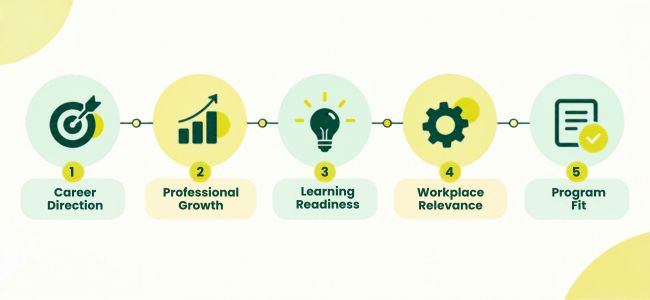
A Simple Framework for Making the Decision
If you are still unsure, step back from the question “Should I pursue an Executive MBA?” and evaluate your situation from a broader perspective.
The following framework can help organise your thinking.
Consideration | Question to Ask Yourself |
Career direction | Where do I want my career to be in the next five to ten years? |
Professional growth | Which capabilities do I need to reach that goal? |
Learning readiness | Am I prepared to balance work, study, and personal commitments? |
Workplace relevance | Will I have opportunities to apply what I learn? |
Program fit | Does the Executive MBA align with my learning objectives and career aspirations? |
There is no score that determines whether an Executive MBA is right for you.
Instead, the decision becomes clearer when these factors align with your personal and professional goals.
Making the Decision With Confidence
Pursuing an Executive MBA is a significant professional decision, and it deserves careful consideration rather than a quick answer. The right choice is not determined by industry trends, peer decisions, or a single career milestone. It is determined by how well the program aligns with your ambitions, responsibilities, and willingness to invest in continuous learning.
If your career goals call for broader business understanding, stronger leadership capabilities, and a structured approach to professional development, an Executive MBA may be an appropriate next step. If those conditions are not yet in place, taking more time to clarify your direction can be just as valuable. The most informed decision is one that reflects your own aspirations and the future you are working toward.
Frequently Asked Questions
1. Should I pursue an Executive MBA?
An Executive MBA may be worth considering if it aligns with your career goals, professional responsibilities, and learning objectives. The decision should be based on your individual circumstances rather than a universal recommendation.
2. How do I know if an Executive MBA is right for me?
Consider your long-term career aspirations, the capabilities you want to develop, your readiness for the commitment, and whether you can apply the learning in your professional role.
3. Can I pursue an Executive MBA while working full time?
Yes. Executive MBA programs are designed for working professionals, although balancing work, study, and personal commitments requires careful planning and consistent engagement.
4. What should I consider before applying?
Evaluate your career goals, current responsibilities, available time, financial commitment, learning objectives, and whether the program aligns with your long-term professional development.
5. Is an Executive MBA suitable for every professional?
No. An Executive MBA is not the right choice for everyone. Its value depends on factors such as career stage, professional aspirations, readiness for continuous learning, and the relevance of the program to individual goals.
6. Will an Executive MBA guarantee career growth?
No educational program can guarantee specific career outcomes. Career growth depends on multiple factors, including professional experience, performance, organisational opportunities, and how individuals apply the knowledge and skills they develop.