Author : Ajeeth Pal Kumaran S – Ex VP of Product at Sony Pictures
Most product teams believe they are building features. They implement improvements, track engagement metrics, optimize funnels, and proceed to the next item on the roadmap. Dashboards turn green, adoption grows, and everything appears to be working.
But the best product leaders understand something deeper. They are not just building features. They are designing economies of behaviour.
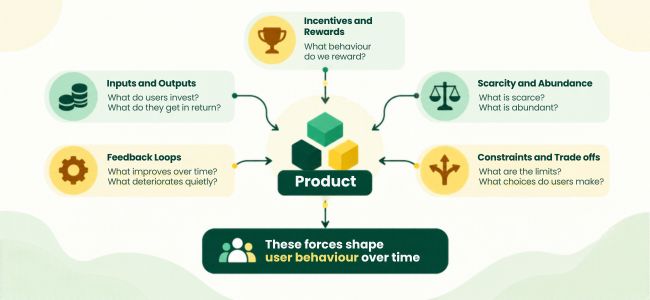
And whether they realize it or not, every product eventually becomes a behavioural system in which incentives, friction, rewards, and constraints shape how users act over time.
The real question is not whether your product has an economy.
It is whether you are designing it intentionally or discovering it too late.
Key Takeaways:
When we discuss product thinking, most discussions focus on features, UX improvements, or growth tactics. But beneath all of that lies something more fundamental: the product’s behavioural economy.
Think about what exists inside any economy:
Now replace a country with a product. Users invest time, attention, effort, and sometimes money. In return, they receive value, status, convenience, or outcomes. The interaction between these forces creates behavioral patterns that scale far beyond individual features.
This is why Aristotle’s famous idea – the whole is greater than the sum of its parts – applies perfectly to products.
A product is not just a collection of features. It is a system in which interactions among those features produce outcomes that no individual feature could produce alone.
Yet most teams rarely ask the most important questions:
When product teams ignore these questions, they risk optimizing metrics while unintentionally undermining the product’s core value.
Three well-known product stories illustrate this perfectly.
Duolingo faced a fundamental challenge.
Language learning is a delayed-gratification activity. Progress is slow. Results are not immediately visible. Mastery takes months or years.
This creates a structural problem:
How do you create motivation in a product where the real reward arrives much later?
Duolingo’s answer was brilliant. They manufactured short-term rewards to sustain long-term learning.
They introduced XP points, streaks, leaderboards, short lessons, instant feedback, and gamified progress. These were not random features. They were deliberate economic design decisions meant to solve one problem:
How do we create immediate rewards for delayed outcomes?
And initially, it worked extremely well. Engagement increased. Daily usage improved. Learning time increased. Users returned consistently.
But something interesting happened next.
Duolingo essentially operates through three loops:
Core loop: Learn → Practice → Feedback → Progress
Engagement loop: Streaks → XP → Leaderboards → Return behavior
Monetization loop: Premium features → Streak freezes → Gems
Ideally, outer loops should reinforce the core loop. Instead, something unexpected happened. Users identified the most cost-effective way to maintain rewards.
Instead of focusing on learning, many users began:
The behaviour being optimized was no longer learning.
It was streak preservation. This reveals one of the most important principles in product economics:
Users will always find the cheapest path to the reward.
If the cheapest behaviour is not your intended behaviour, your product economy will drift. And that is exactly what happened. Duolingo’s engagement system worked perfectly. But it started optimizing the wrong behaviour.
The situation became more complex due to personalization.
Personalization systems typically reinforce existing behaviour. If a user behaves like a streak optimizer, the system may surface easier lessons. If they behave like a serious learner, more difficult lessons arise. This seems logical. But it creates a hidden risk:
Personalisation reinforces current behaviour rather than intended behaviour.
This can polarize users rather than guide them. We see this clearly in social media. Watch a few types of videos, and your feed will fill with similar content. Engagement increases, but discovery decreases.
Duolingo faced a similar issue. Their system unintentionally encouraged different types of learners to drift further apart in behaviour.
Duolingo’s correction did not involve removing gamification. Instead, they rebalanced the economy.
They introduced:
Most importantly, they introduced a new proxy metric:
Time spent learning well.
This measured meaningful learning progression rather than a simple activity. This highlights a powerful lesson:
Engagement metrics are proxies. If your proxy becomes the goal, your product risks losing its purpose.
Good product governance requires constantly asking:
Because drift is inevitable. Governance is what determines whether you catch it early.

Sometimes systems fail not because they were designed poorly. They fail because user behaviour changes outside them.
BigBasket developed a highly successful grocery model based on planned consumption.
Their system rewarded weekly planning, basket consolidation, and larger purchases, as well as scheduled delivery. This worked extremely well. Repeat rates were strong. Basket sizes were growing. Slot utilization was high. Everything looked healthy.
But an important assumption sat underneath this model:
Users are willing to plan ahead.
And that assumption quietly started breaking.
Historically, grocery buying operated on three rhythms:
Daily purchases → Local stores
Weekly purchases → Supermarkets
Monthly purchases → Wholesale stores
These formats coexisted because they addressed different constraints, such as income cycles, storage capacity, and planning capacity.
BigBasket moved weekly planning online. Subsequently, companies such as MilkBasket reduced planning to 12 hours. Then COVID accelerated behavioural change dramatically. Doorstep delivery became a matter of safety, not convenience. Then Dunzo demonstrated that instant logistics could scale. Then Zepto removed planning completely.
Zepto did not invent grocery delivery. They changed the planning horizon from days to minutes.
They removed minimum order sizes, waiting time, and planning requirements
They introduced:
This shifted the governing unit of demand from planned occasions to impulse needs.
And once users experience reduced waiting time, expectations rarely revert.
This is called convenience elasticity.
Once the acceptable wait time drops, it rarely increases again.
The most dangerous part? BigBasket’s metrics still looked healthy. Large orders continued. Repeat rates remained strong.
But hidden signals existed:
This reveals another product lesson:
What you don’t measure, you can’t defend.
By the time shifts in behaviour become evident in revenue, competitors may already have captured new demand.
Zepto’s real innovation was economic rather than product-driven.
They changed demand frequency, basket size assumptions, supply chain design, unit economics, and user expectations. But their model also depends on deferred friction.
Venture funding, rather than users, partially absorbs delivery costs.
Which raises a strategic question:
What happens when the true cost returns to the user?
Behaviour elasticity becomes the next unknown.
This highlights another product principle:
Products rarely lose to better features. They lose to better economic structures.
Gamification is most effective when it amplifies real value. It fails when it tries to replace the value.
This became clear in payment apps. Initially, wallet cashback created a closed loop:
Pay → Earn cashback → Spend cashback → Repeat
There was a clear sink for rewards. When UPI emerged, the loop broke.
Cashback went directly to bank accounts. Users could switch apps freely. Loyalty mechanisms weakened. Without sinks, reward systems inflate.
And inflation leads to fatigue.
Early cashback offered meaningful rewards.
Then rewards shrank:
₹50 cashback → ₹5 cashback → Coupons → Deals
Uncertainty is meaningful only when the potential reward is meaningful. When rewards lose their aspirational value, gamification becomes noise. Scratch cards slowly became ad surfaces. Users stopped caring.
Healthy economies require effort before reward. Games require skill or stakes. Wallets require usage commitment. UPI rewards often required nothing extra. Payments would happen anyway.
When reward exceeds effort, systems become unsustainable.
When effort disappears, emotional attachment disappears. And when attachment disappears, engagement becomes superficial.
Not all products benefit equally from gamification.
Discretionary products:
Gamification is effective here because use is optional.
Need-based products:
Gamification cannot create demand here. It can only support it. Utility must exist first.
Then, gamification can enhance it.
This is why payments platforms are shifting toward smart reminders, financial discovery, lending, and cross-selling. Because data, not rewards, is their real asset.
One of the most subtle problems in large product organizations is fragmentation.
Different teams optimize different metrics:
But who optimizes system health? In gaming companies, economy designers exist for this purpose. Many product organizations lack this equivalent role. Without ownership, systems drift toward local optimization rather than global balance.
And economies eventually fracture.
Across these three stories, a pattern emerges. Product leaders are not just feature builders.
They are:
And their job requires answering three continuous questions:
Every product eventually becomes a behavioural economy.
You can ignore it, discover it late, or design it intentionally.
The difference between average product teams and great product leaders is simple – average teams ship features. Great product leaders design systems.
Because in the long run, features don’t determine product success.
The behaviours they create do.
A behavioural economy in product management refers to how incentives, rewards, friction, and constraints inside a product shape user decisions over time. Every product creates these behaviour patterns – either intentionally through design or unintentionally through feature interactions.
Engagement strategies fail when they reward the wrong behaviour or focus only on activity metrics instead of real value creation. If users find shortcuts to rewards without using the core product meaningfully, engagement may increase while actual value decreases.
Gamification improves retention by providing short-term motivation through rewards like streaks, points, or progress indicators. However, it works best when it supports the core value of the product rather than becoming the main reason users return.
Product managers should track outcome-focused metrics such as value delivered, quality of usage, and meaningful progression instead of just session time or frequency. These metrics help ensure growth aligns with the product’s real purpose.
Product leaders can design better systems by aligning incentives with desired behaviours, identifying behavioural shortcuts early, monitoring shifts in user habits, and continuously balancing the product’s incentive structure to maintain long-term value.