AI adoption is no longer the difficult part. Organizations are already using AI across product development, engineering, customer service, analytics, prototyping, and increasingly complex agentic workflows.
The harder question is commercial: How does AI usage translate into measurable revenue?
An AI capability may work technically. Customers may use it. The model may perform well. None of that automatically proves that the product creates something customers will pay for or that its economics will remain attractive as usage grows.
This is the emerging AI monetization gap.
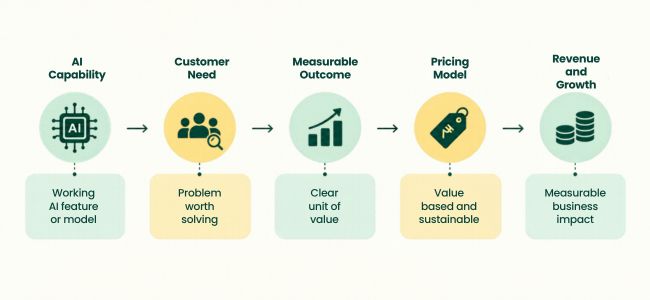
Closing it requires product leaders to move beyond models and features. They need to define what customers are actually buying, identify a measurable unit of value, understand the cost of delivering it, design defensible pricing, and produce evidence that the promised outcome occurred.
Key Takeaways:
A company can deploy AI across multiple functions and still struggle to explain how those investments improve profitability.
The difficult part is increasingly not getting AI to work. It is proving that AI creates enough economic value to justify its cost.
Three problems make this particularly difficult:
These are not simply model problems. They are product and business-model problems.
A better model alone cannot solve them.
Customers rarely care how many tokens an AI system consumed. They care about what happened.
Was a support problem resolved? Was an invoice generated? Was code successfully produced? Was a manual workflow eliminated? Did the customer save time or money?
As AI models become increasingly competitive, the commercial conversation shifts from the underlying technology toward the outcome delivered by the complete product.
This is also why hybrid and outcome-based pricing models are becoming important.
Customers rarely care how many tokens an AI system consumed. They care about what happened.
Was a support problem resolved? Was an invoice generated? Was code successfully produced? Was a manual workflow eliminated? Did the customer save time or money?
As AI models become increasingly competitive, the commercial conversation shifts from the underlying technology toward the outcome delivered by the complete product.
This is also why hybrid and outcome-based pricing models are becoming important.
Traditional SaaS could often charge a predictable subscription per user or account. AI complicates this because two customers paying the same subscription can create dramatically different inference costs.
Hybrid pricing addresses this through a base subscription plus additional charges linked to AI usage or value.
Outcome-based pricing goes further by charging for the result itself. But it introduces an important requirement: both buyer and seller must agree on exactly what counts as a successful outcome.
Before pricing an AI capability, product leaders should test the proposed billable unit against four questions.
The value should be recognizable.
Consider a business where an employee spends much of the day creating dozens of invoices. If AI reduces that workflow to minutes, the customer can clearly see the improvement.
That creates a tangible basis for value.
Suppose a customer-support AI charges per “resolution.”
What counts as resolved?
Is it a conversation that did not escalate to a human? A ticket that was closed? Or a problem that the customer confirmed had disappeared?
If buyer and seller measure different events, invoice disputes are inevitable.
Higher AI usage can increase inference costs, but greater vendor cost does not automatically mean greater customer value.
Product leaders need to distinguish between charging more because the product delivers more value and charging more simply because AI costs more to operate.
AI products change continuously. Models, features, costs, and usage patterns evolve.
If a customer signs an annual agreement, the company needs evidence showing why that price remains justified months later.
A pricing model that cannot survive procurement scrutiny is not durable.
The definition of an outcome matters more than it initially appears.
Imagine an AI support vendor reporting a high resolution rate while the customer records a much lower one.
Neither side necessarily has to be dishonest.
The vendor may count conversations that did not escalate. The customer may count only problems that were demonstrably solved.
The disagreement exists because the billable event was never clearly defined.
A stronger approach establishes what constitutes a resolution, how it will be measured, when it will be verified, and what happens if the result is disputed.
This is where evidence becomes part of the product itself.
AI provenance is often treated as a governance or compliance concern. It also has direct commercial value.
When an AI system produces a billable outcome, the company may eventually need to demonstrate:
That becomes particularly important when customers dispute charges.
The closer a company moves toward outcome-based pricing, the more important verifiable evidence becomes.
Provenance is therefore not merely a compliance feature. It can become part of the pricing architecture.
AI teams commonly measure groundedness, accuracy, reliability, variance, inference cost, and safety. But averages can be misleading.
An AI product could report excellent average accuracy while performing poorly for a strategically important customer segment.
Product leaders therefore need to ask:
Which customers receive the weakest outputs? Where does reliability break? Which use cases have the greatest variance? What happens among customers with the highest willingness to pay?
Technical metrics become commercially meaningful when they connect to customer outcomes and revenue.
The same applies to inference cost.
Knowing the total model bill is insufficient. Teams need to know:
What does one billable outcome cost today, and what will it cost at 100 times the current volume?
Without that answer, pricing is closer to a guess than a strategy.
AI metrics also need to reflect what the business actually needs.
Consider a text-to-SQL system. The generated queries may execute successfully most of the time, yet a smaller percentage may return the correct answer.
Execution success and business correctness are not the same thing.
This becomes dangerous when users make decisions based on plausible but incorrect numbers.
AI systems therefore need evaluations and guardrails that test whether an output meets the expected standard, rather than simply accepting the first generated response.
The right question is not: Did AI produce an output?
It is: Was that output reliable enough to act on?
Traditional software monitoring answers questions such as:
Is the system online? What is its latency? What is the error rate? How much throughput is it handling?
Those remain important, but AI introduces another requirement.
An autonomous system can have excellent operational metrics while making poor business decisions.
The transcript illustrates this with a healthcare revenue-cycle agent that silently approved millions in non-covered procedures while conventional operational indicators remained healthy.
The distinction is critical: Monitoring tells you whether the system is running. Evidence tells you what it decided and why.
That evidence becomes especially important when AI decisions have financial, customer, or regulatory consequences.
Suppose a customer disputes an AI-generated charge months later.
Can the company identify what happened? Can it determine which model version was used? Can it reconstruct the relevant inputs and evaluations? Can it explain why the outcome qualified for billing?
If it cannot, the commercial model becomes fragile. This leads to one of the most important principles of AI monetization:
You cannot reliably monetize what you cannot prove.
Evidence, explainability, and reconstruction are therefore not peripheral engineering concerns. They support revenue.
Traditional software companies could often serve additional customers at relatively low marginal cost.
AI introduces significant variable expenses.
Every interaction can consume tokens. Agentic workflows may trigger multiple model calls, tools, retries, and evaluations. Greater usage can therefore increase costs significantly.
Flat pricing becomes risky when a small group of power users creates disproportionately high inference expenses.
This forces companies to decide whether to absorb the costs, restrict usage, or redesign pricing.
The lesson is not that usage-based pricing is always better. It is that AI usage patterns need to be modeled before scale makes them a margin problem.
AI capabilities generally create three packaging choices.
Bundle AI into the base product when it improves something customers already buy and the incremental cost is small and predictable. This keeps pricing simple but can hide customers’ willingness to pay for AI.
Offer AI as an add-on when usage varies widely and a minority of customers creates most of the cost. This protects margins while testing willingness to pay.
Create a separate AI offering when AI performs a fundamentally different job for a different buyer or budget. In that case, it can become a new revenue line rather than an enhancement to an existing product.
The choice should depend on customer value, cost variability, buying behavior, and go-to-market strategy.
Product teams do not need to redesign their entire pricing model immediately. Monetization can be tested systematically.
Week 1: Name the billable unit. Define exactly what the customer pays for and test whether it is visible, measurable, scalable with value, and defensible.
Weeks 2–4: Instrument the cost. Calculate the fully loaded cost of delivering one unit today and model what happens at significantly higher volume.
Month 2: Publish the definition. Write the unit clearly enough that a procurement team could understand and challenge it.
Month 3: Run a pricing experiment. Choose one customer segment, one pricing model, and one explicit hypothesis. Treat it as an experiment rather than an organization-wide repricing.
This turns AI monetization into a product-learning process rather than a pricing exercise performed after launch.
Despite the complexity of models, inference, pricing, and evaluation, product fundamentals remain unchanged.
Before adding AI, teams still need to understand the customer problem.
Who experiences it? How significant is it? Will AI materially improve the outcome? Will customers pay for that improvement? Could a simpler solution work just as well?
AI should not become a shortcut around customer discovery.
The transcript’s invoice example captures this well. If AI can reduce the work of producing dozens of invoices from an entire day’s effort to minutes, there is a visible outcome that can potentially be measured, priced, and defended.
AI economics cannot sit entirely with engineering or finance.
Tokens may be an infrastructure expense, but they affect product viability. Inference may be technical, but it affects margins. Evaluations may appear to be model-quality work, but they determine whether outcomes can be trusted. Provenance may look like compliance, but it determines whether outcomes can be proven.
These concerns converge at product leadership.
Customers should not be asked to solve the vendor’s token problem. They should be asked to pay for value.
AI products are moving from technological experimentation toward commercial accountability.
The important question is no longer simply whether AI can perform a task.
Companies need to determine whether that task creates measurable customer value, whether the outcome can be verified, whether its economics work at scale, and whether customers are willing to pay for it.
The companies that close the AI monetization gap will connect customer value, measurable outcomes, evidence, pricing, and unit economics into one coherent product system.
Because the most important principle is also the simplest:
You cannot monetize what you cannot prove.
AI products can be monetized through subscription, usage-based, outcome-based, or hybrid pricing. The right model depends on how customers experience value, how variable AI costs are, and whether the outcome can be clearly measured. Increasingly, companies are combining predictable base fees with usage or outcome-based components.
Outcome-based pricing charges customers when the AI delivers a defined, measurable result, such as resolving a support ticket or completing a workflow. It aligns pricing with customer value rather than tokens or model usage, but requires clear attribution and a verifiable definition of what counts as a successful outcome.
AI ROI should compare the measurable value created, such as revenue gained, costs reduced, time saved, or risk avoided, against the full cost of implementing and operating the AI system. Teams should prioritize business outcomes over activity metrics such as prompts, tokens, or tasks processed.
There is no single best model. Subscription pricing works well for predictable usage, usage-based pricing suits variable consumption, and outcome-based pricing works when results are measurable and attributable. Hybrid pricing is increasingly useful when companies need both predictable revenue and protection against variable AI costs.
Unlike traditional software, AI products often incur variable costs every time models run. Tokens, inference, tool calls, retrieval, retries, and other compute requirements can make costs rise alongside usage. Product teams therefore need to understand the cost per customer or billable outcome before setting prices and scaling the product.