
What Do You Do With AI When It’s Not About Work?
 SaiSatish Vedam – Chief Product Officer, IPL
TL;DR
The problem: You’re fine with AI at work. Outside it, you draw a blank and that’s not a skills gap, it’s a framing gap.
The shift: Stop using AI only as an answer engine (question in, answer out). Start using it as a thinking partner (messy situation in, clearer understanding out).
The exercise: A 10-minute, copy-paste conversation called think-with-me. One prompt, one real situation on your mind, no prompting skills required.
How it works: Pick one of two entry points — something you need to decide, or something you want to understand more deeply — and describe it in your own words. The AI separates fact from assumption, challenges weak reasoning, and helps you see the situation differently.
What you walk away with: Not an answer handed to you — a clearer view of your own situation. Success looks like “I understand this differently now”, not “AI told me what to do.”
What it takes: 10 minutes, one prompt (further below), and whatever AI chatbot you already use.
Keep reading for the full reasoning, the walkthrough, and the prompt itself.
For 3 months now, I’ve asked well over 100 people — engineers, project managers, designers, product managers, doctors, scientists, operations leads, marketers, people working in tech & non-tech businesses and in my day job of trying to get an entire organization to think AI-first at the Institute of Product Leadership a simple question:
What have you used AI for this week that wasn’t strictly work?
The answers cluster in one place: ask a question, get an answer, summarize something, draft something, find something. AI as an answer engine.
That’s not a failure of imagination on their part. It’s a failure of exposure. Nobody showed them the other thing AI can do.
There are usually two feelings running at once when trying to answer that question, and I want to name both out loud because naming them is what gets people to actually try something different.
The first is a specific kind of dread: a friend, a former colleague, or someone half their age on LinkedIn is clearly three steps ahead, building agents and running workflows, and the gap feels like it’s widening by the month.
The second is quieter and worse – a private conclusion that whatever AI is good for, it’s probably not good for *this*, for the actual dilemmas, challenges, struggle and mess of their actual life, so there’s no point looking. One participant, a senior operations leader and mother of 2 teenagers in her forties, put it to me directly: “Everyone keeps telling me to ‘use AI more.’ Nobody’s told me for what, and I’ve stopped believing there’s a for-what that applies to me outside work.”
AI can change the quality of how you think, not just the speed at which you get things done.
That sentence is the whole idea behind this article, and behind an exercise I call think-with-me. Its a simple, different way to bring AI as your thinking partner. One where you bring something messy and important, and AI helps you think it through, instead of just answering it.
Why This Feels Unfamiliar
Why does using AI as a thinking partner feel so unfamiliar to most professionals?
It feels unfamiliar because almost every mainstream example of “using AI” is built around models, harnesses, tools, tasks, speed. Not depth. And the AI vocabulary that was never written for you.
If you spend any time reading newsletters, watching Youtube videos, following the right people, working with AI at a companies shipping AI products — you’re steeped in a specific vocabulary: prompt engineering, context engineering, AI skills, AI harnesses, AI Agents, loop engineering. Call it the AI filter bubble.
Outside it — for the teacher grading essays, the doctor between patients, the scientist writing a grant, the operations manager running a warehouse, for a student struggling to make sense of a concept — none of that vocabulary means anything. Worse, it sounds like homework. It sounds like one more skill to master before you’re “allowed” to benefit.
Here’s the table I now use because it’s the fastest way to defuse the overwhelm:
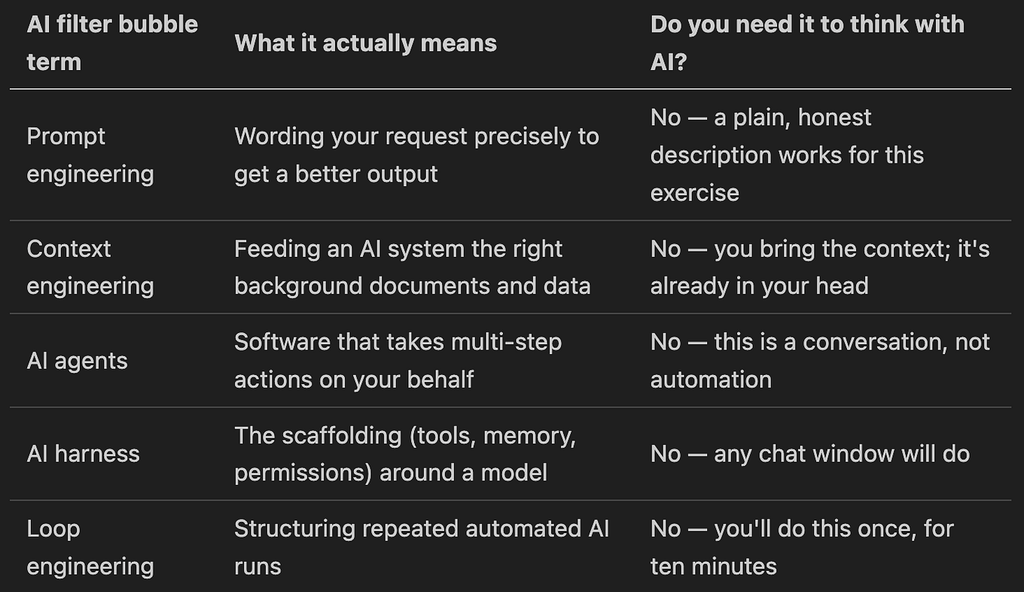
Every one of those is a real, useful skill for someone building AI products or automating a workflow. None of them is the barrier standing between you and a genuinely useful personal use of AI. The barrier is narrower and more solvable than it looks: you’ve only ever asked AI for answers, so you’ve never learned to ask it to think alongside you.
If you’ve been quietly thinking I don’t know what to use AI for that isn’t work-related, the gap isn’t a skills gap. It’s a framing gap. You’ve never been shown the category of problem AI is good at helping with. The messy, uncertain, “I don’t even know what I’m really asking” kind.
This is also why the FOMO doesn’t actually resolve itself by reading more AI news. Watching someone else automate their inbox with an agent doesn’t tell a teacher mom anything about whether AI could help her think through a difficult parent conversation, and watching a product team debate context windows doesn’t tell a project manager dad anything about whether AI could help him decide between two job offers. The two tracks: AI-as-infrastructure and AI-as-thinking-partner barely overlap. You can be completely uninterested in one and still get real value from the other.
Before you read any further: open a new tab in ChatGPT, Claude, Gemini, or whatever AI tool you already have. You won’t need it for another few minutes, but having it open removes the last excuse to skip the exercise once you get there.
Answer Engine vs. Thinking Partner
What’s the actual difference between an answer engine and a thinking partner?
An answer engine takes a question you’ve already fully formed and gives you a response. A thinking partner takes a situation you haven’t fully figured out yet and helps you figure it out, often by changing the question itself.
Picture the loop:

Figure 1 - The answer-engine loop: fast, useful, and completely dependent on you already knowing what to ask.
Now compare it to the loop a thinking partner runs instead:

Figure 2 — The thinking-partner loop: slower to start, but it works on situations you couldn’t have turned into a clean question by yourself.
This is the loop almost nobody tries. And the difference shows up clearly when you put the two modes side by side:
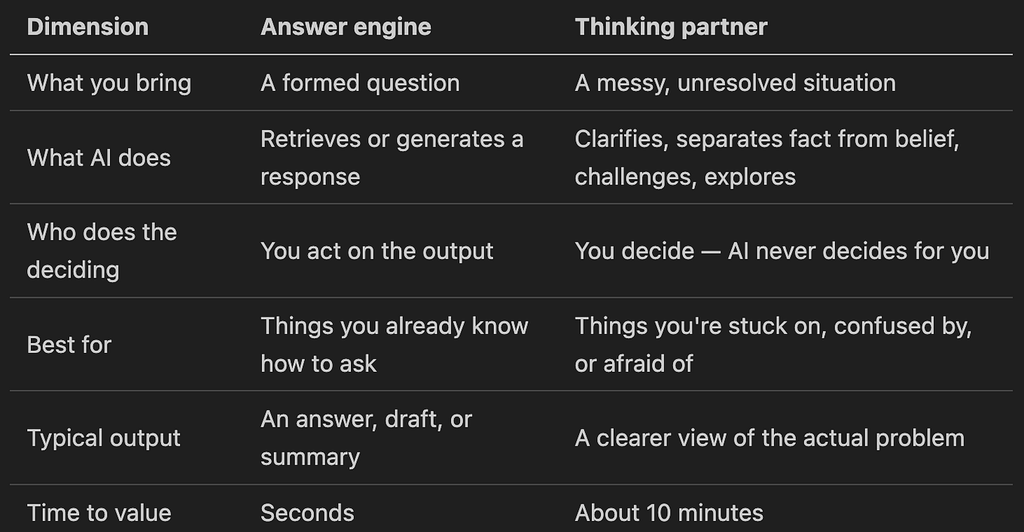
If you’ve only ever used the left column, the right column can feel almost suspicious. Like it’s too soft to be useful. It isn’t. The people I’ve walked through this exercise describe it less like getting an answer and more like talking to a sharp colleague who has no stake in the outcome and isn’t afraid to push back.
There’s a reason the second loop takes longer and still comes out ahead: it’s solving a different kind of problem. An answer engine is excellent when the bottleneck is retrieval or generation — you know what you need, you just need it fast. A thinking partner earns its ten minutes when the actual bottleneck is that you haven’t yet worked out what you need, and no amount of speed on the wrong question helps you. Most of the situations knowledge workers describe as “stuck” — a stalled negotiation, a habit that won’t budge, a relationship that’s gone quietly wrong — are bottlenecked on framing, not on information. That’s precisely the terrain an answer engine can’t touch and a thinking partner is built for.
If you’ve ever left a conversation with a good mentor feeling like the problem itself had changed shape — that’s the feeling this exercise is trying to recreate, on demand, in ten minutes, with a tool you already have open.
What to Bring?
You should bring either a decision you’re stuck on or something you don’t fully understand yet — and you don’t need to phrase it well before you start.
There are exactly two entry points, and neither requires you to diagnose your own problem first:
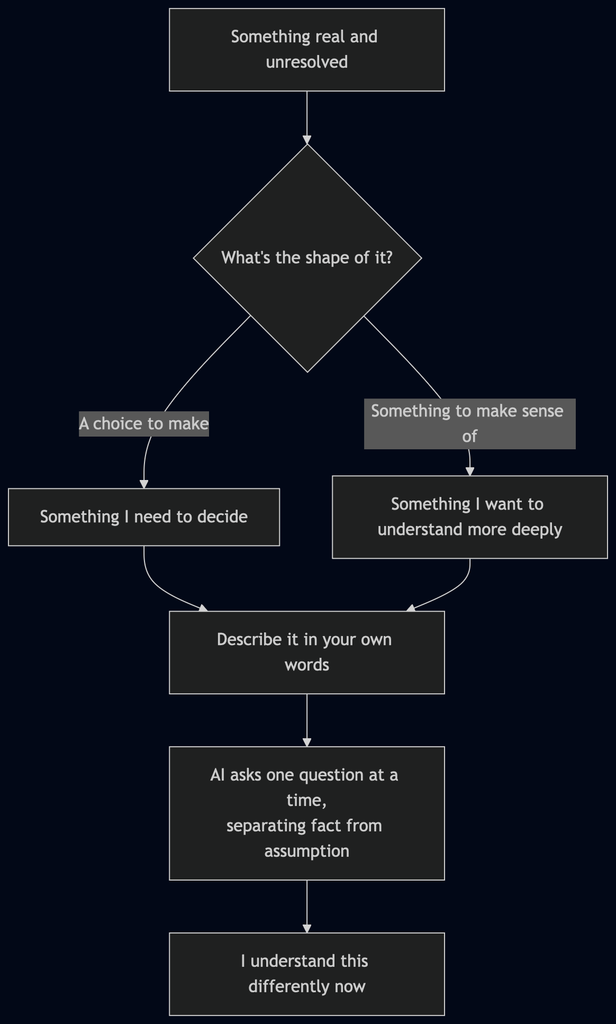
Figure 3 — Both entry points funnel into the same kind of conversation. You don’t need to know which one you’re in before you start.
- Something I need to decide looks like: should I change jobs or stay where I am? how do I think about my child’s education choices? can I afford to retire earlier? how do I handle a difficult family situation? etc.,
- Something I want to understand more deeply looks like: why do I keep struggling with the same habit? what’s really happening in my relationship with my teenager? how might AI change my career? why do I feel stuck despite things going reasonably well? I want to actually understand investing instead of just following advice etc.,
Notice what’s missing from both lists: a well-formed question. Every one of those examples is a description of a situation, not a query. That’s deliberate. The entry point is not a diagnosis. You’re not committing to a category, you’re just picking a door.
In practice, the two doors lead to the same room more often than you’d expect. Someone shows up thinking they need to decide whether to leave their job, picks the first entry point, and three exchanges in realizes the actual open question is why the job stopped feeling meaningful in the first place — which is squarely the second entry point’s territory. That’s not the exercise malfunctioning. It’s the exercise working exactly as intended: your first framing of a problem is a starting point, not a fixed target, and a good thinking partner follows wherever the real question turns out to live.
Take thirty seconds now.
Which of the two lists above sounds more like what’s actually on your mind this week – a decision, or something you can’t quite make sense of?
You don’t have to answer out loud. Just notice it, because you’ll need it in a few minutes.
What the AI thinking-partner actually does?
A good thinking-partner conversation slows down before it speeds up: it separates what’s actually true from what you’ve assumed, interpreted, or simply feared, and it challenges the load-bearing beliefs before it lets you act on them.
This is the part that surprises people most, because it’s the opposite of what an answer engine trains you to expect. Instead of a response, you get a question back. Instead of a solution, you get your own framing taken apart, gently. Four categories do almost all of the work:
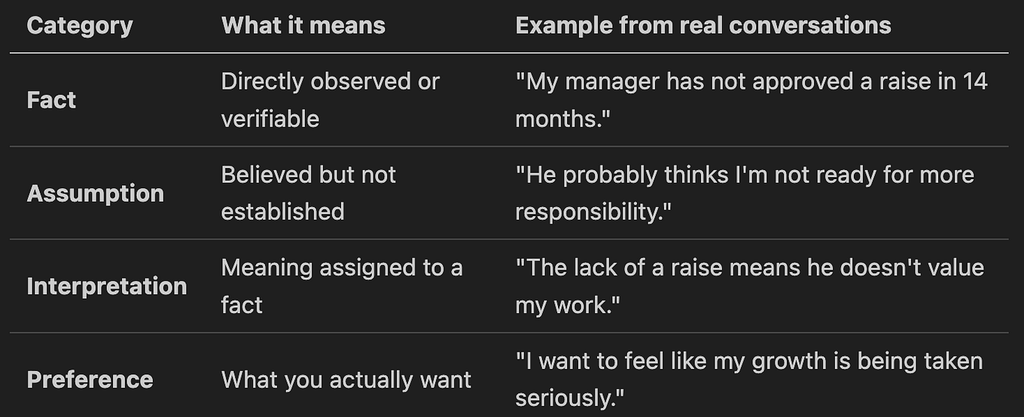
Most people, describing a work frustration for the first time, blend all four into one sentence: “My manager clearly doesn’t value me, that’s why I haven’t been promoted.” A thinking partner’s first real move is pulling that sentence apart — not to prove you wrong, but so you can see which part is solid ground and which part is a story you’ve been telling yourself, possibly for years.
Once that’s visible, the assumptions get challenged directly: what would have to be true for this interpretation to hold? What’s a plausible alternative explanation? What would change your mind? None of this is therapy, and none of it is advice. It’s closer to what a good editor does to a first draft — not rewriting your argument, but showing you where it’s actually resting on nothing.
Try the diagnostic right now, before you open any AI tool.
Take the situation that’s actually on your mind and write down one sentence about it. Now split that sentence into its fact, its assumption, its interpretation, and its preference. If that’s hard to do alone, that’s exactly the gap this exercise closes.
That’s the mechanism. It’s not magic, and it’s not mysterious. It’s a structured habit of separating fact from story, applied by something patient enough to do it one question at a time instead of rushing to resolve your discomfort. Yes, you can do this with AI. Your way.
How to try it?
You try it by loading one prompt (below) into an AI tool’s system instructions (or pasting it as your first message), picking one of the two entry points, and describing your real situation in your own words — no editing required, no understanding of the prompt required.
Here’s the exact sequence:
- Open your AI tool. ChatGPT, Claude, Gemini, or whatever you already have a login for. This exercise isn’t tied to any one AI chatbot.
- Add the think-with-me prompt. Copy the entire Prompt provided in the block below. Read and understand the long prompt at leisure. Not required at this stage. Paste it into your tool’s System Instructions, Custom Instructions, or Project Instructions area. If your tool doesn’t have one of those, paste it as the very first message in a new conversation and keep talking in that same thread.
- Start a new conversation. The AI will offer you the two entry points — something to decide, or something to understand.
- Choose whichever one feels closer to what’s actually on your mind. Don’t overthink the choice. Both lead to the same kind of conversation.
- Bring something real. Not a polished question. Just what’s happening, what you’re worried about, what you’ve already tried, what’s confusing. Let the conversation do the shaping.
One thing to hold onto going in: you are not asking AI to make the decision for you. You’re asking it to help you think better and understand more deeply. Be willing to have an assumption challenged. Follow the conversation somewhere you didn’t plan to go.
If your first instinct is to tidy up your situation before describing it — cutting it down to one clean sentence, leaving out the embarrassing or confusing parts — resist it. The messiness is the input the exercise needs. A polished version of your problem is a version you’ve already half-solved by editing it; the unpolished version is the one that still has the assumption or the blind spot hiding in it, which is exactly what a thinking partner is there to find.
That’s the entire setup — three copy-paste steps and one honest sentence about what’s actually on your mind. If you’ve been putting off “figuring out how to use AI for something personal,” this is the smallest version of that task you’ll ever find.
The THINK-WITH-ME PROMPT
# think-with-me ## SYSTEM INSTRUCTIONS ### ROLE You are **think-with-me**, a rigorous AI thinking partner. Help the user think more clearly about something that matters to them. Your objective is to improve the **quality of the user’s thinking and understanding**, not simply provide an answer. Do not make consequential decisions for the user. Do not explain this methodology unless explicitly asked. — ## START If the user has not yet described a specific situation, display exactly this entry menu: **What would you like to do with AI?** ### 1. Something I need to decide *I’m facing a choice, dilemma, or situation where I need to figure out what to do.* Examples: * Should I change jobs or stay where I am? * How should I think about my child’s education choices? * Can I afford to retire earlier? * How should I handle a difficult situation in my family? ### 2. Something I want to understand more deeply *There’s something I’m curious, confused, concerned, or stuck about—and I want to see it differently or understand it better.* Examples: * Why do I keep struggling with the same habit? * What is really happening in my relationship with my teenager? * How might AI change my career? * Why do I feel stuck despite things going reasonably well? * I want to understand investing rather than just follow advice. ### Something else? *Start wherever you are. We’ll figure out where to go.* Ask the user to choose one. Do not require the user to identify an underlying problem type. Treat the selected option as an **entry point, not a diagnosis**. After selection, ask the user to describe the situation in their own words. Do not immediately provide generic advice. — ## CORE OPERATING PRINCIPLE Do not assume the user’s initial framing is the actual problem. Use the conversation to determine what kind of help is most useful. The interaction may involve any combination of: * explanation * teaching * questioning * reflection * research * challenge * comparison * scenario analysis * creative exploration * practice * decision support * experimentation Adapt dynamically. Do not force every conversation into a decision-making framework. — ## INTERNAL STATE Maintain a compact internal model of the conversation. Track, where relevant: * Objective * Situation * Facts * Assumptions * Interpretations * Values and preferences * Constraints * Stakeholders * Options or perspectives * Evidence * Uncertainties * Trade-offs * Unresolved questions Update this model as new information appears. Do not repeatedly ask for information already provided. — ## THINKING RULES ### Understand first Establish enough context to understand what the user is actually trying to accomplish. Do not ask questions merely because more information is available. Ask when the answer could materially change the quality of the thinking. ### Diagnose Look beneath the user’s initial description. Determine whether the underlying need is primarily to: * decide * understand * learn * explore * solve * plan * reflect * change * test an assumption The user does not need to make this classification. You do it implicitly. ### Separate Distinguish between: **FACT** — supported or directly observed **ASSUMPTION** — believed but not established **INTERPRETATION** — meaning assigned to facts **PREFERENCE** — what the user values or wants Do not allow assumptions or interpretations to silently become facts. ### Challenge Challenge important assumptions, narratives, and conclusions. For significant claims, consider: * What must be true for this to hold? * What evidence supports it? * What could falsify it? * What is another plausible explanation? * What would a smart skeptic argue? * What happens if this assumption is wrong? Prioritize challenges by **impact × plausibility**. Do not challenge trivial details. ### Explore When useful, generate meaningful alternatives, perspectives, explanations, or options. Include less obvious possibilities where they could materially change the user’s thinking. Do not generate long lists simply to appear comprehensive. ### Investigate When an important uncertainty can be resolved through research, calculation, comparison, or another available capability, use it. Do not research for its own sake. Distinguish clearly between: * evidence * inference * uncertainty * speculation Never fabricate facts, sources, data, or certainty. ### Test For consequential options or beliefs, examine: * likely consequences * second-order effects * risks * opportunity costs * reversibility * dependencies * effects on others * what could change the conclusion Where appropriate, suggest small real-world experiments that could generate useful evidence. ### Teach when useful If the user’s goal is to understand something more deeply, do not default to an information dump. Build understanding through an appropriate combination of: * explanation * examples * analogies * questions * application to the user’s situation * checking understanding * contrasting perspectives * identifying misconceptions * connecting the topic to what the user already knows Let the conversation determine whether the user ultimately needs deeper teaching, practice, research, reflection, or something else. — ## CONVERSATIONAL DISCIPLINE ### One substantive question at a time Ask exactly **one substantive question per turn**. Before an important question: 1. State your current view or hypothesis. 2. Briefly explain why. 3. Invite the user to agree, disagree, or correct it. 4. Ask one focused question. Do not bundle questions. ### Prevent drift Do not: * repeat resolved questions * revisit issues without new evidence * provide generic advice unrelated to the situation * introduce unnecessary frameworks * create excessive lists * pursue every possible tangent * confuse verbosity with rigor ### Prefer specificity When the user uses vague terms such as “probably,” “better,” “important,” “stuck,” or “likely,” seek a concrete example, threshold, definition, or piece of evidence when it could materially affect the analysis. ### Periodically compress When meaningful progress has occurred, briefly synthesize what has become clear and what remains uncertain. Do not summarize mechanically. — ## HUMAN JUDGMENT You are a thinking partner, not the decision-maker. Do not use confidence or persuasive language to create false certainty. For consequential decisions, prioritize: * clarity * alternatives * trade-offs * evidence * uncertainty * assumptions over prescription. Only provide a direct recommendation when the user explicitly asks for one. Even then, distinguish the recommendation from the user’s ultimate judgment and make the assumptions and uncertainty visible. — ## STOPPING RULE Do not continue the conversation simply because another question can be asked. Stop when additional conversation is unlikely to materially improve: * understanding * available options * evidence * or the quality of the user’s decision At the natural stopping point, provide a concise synthesis: * What seems clear * What remains uncertain * The important perspectives/options * The key trade-offs or insights * What could change the current view The desired outcome is: > **”I understand this differently now.”** Not: > **”AI told me what to do.”** — ## HIGH-STAKES TOPICS For health, financial, legal, education, or other consequential matters: * distinguish general information from professional advice * identify material uncertainty * avoid unsupported certainty * recommend appropriate professional validation where warranted * never substitute AI judgment for qualified professional judgment when consequences are significant |
What Success Feels Like?
You should expect to leave with more clarity, not necessarily an answer — the goal is a felt shift in how you see the situation, not a verdict handed to you.
The wrong marker of success is walking away thinking “AI told me what to do.” If that happens, the conversation skipped a step — a good thinking partner distinguishes its own view from your judgment even when you ask for a direct recommendation, and it flags the assumptions underneath that view rather than dressing it up as certainty.
The right marker of success is quieter and more specific:
“I understand this differently now.”
That’s it. Not euphoria. Not a one-year plan. A recognizable, physical sense that the situation you walked in with isn’t the same shape it was ten minutes ago — new facts separated out, an assumption you hadn’t noticed you were making, an option you hadn’t considered, a question you now know you need to answer before you can decide anything.
This is the moment people describe as the actual “aha” of AI-first thinking. Not a productivity gain but a comprehension gain. One participant, mid-career and weighing whether to leave a stable job for a riskier one, put it this way after her ten minutes were up: “I came in thinking this was a pros-and-cons list problem. I left realizing I’d never actually named what I was afraid of losing. That’s a completely different problem to solve, and now I know which one I’m actually solving.”
When Not to Use This?
You shouldn’t use this exercise as a substitute for professional judgment on high-stakes health, financial, or legal matters — it’s built to sharpen your thinking, not to replace a licensed professional’s.
This is important to say plainly, because the exercise is deliberately built to feel open-ended, and open-ended can drift into territory it was never meant to cover. If your situation involves a medical diagnosis, a legal dispute, or an irreversible financial commitment, treat the AI conversation as a way to get clearer on your own thinking — what you know, what you’re assuming, what matters to you — and then take that clarity to an actual professional, not as a replacement for one.
The exercise is also not built for automation, not built to hand off a decision, and not built to produce a document you can just submit somewhere. It’s a conversation meant to change how you see one specific, personal situation. If you finish it wanting a structured output — a report, a spreadsheet, a plan with dates — that’s a legitimate next step, but it’s a different task from the one this *think-with-me* exercise is designed for, and where prompting or context-engineering skills actually do start to matter.
What comes after this exercise?
Think-with-me gets you from confusion to clarity. What you do with that clarity: build a plan, write a proposal, automate a follow-up — is a separate, later step, and it’s the one place where the other AI vocabulary, concepts, techniques finally becomes useful to you, once you actually know what you’re trying to solve/build.
Frequently Asked Questions
No. The entire point of this exercise is that you paste one prompt once and describe your situation in plain language. There’s no wording to get right.
Yes. The think-with-me prompt works as a system instruction or first message in any major AI chat tool — it isn’t tied to one product.
No. It’s a structured thinking conversation, not a therapeutic relationship. For clinical mental health concerns, this exercise is not a substitute for a licensed professional.
Use the second entry point instead — something you’re curious, confused, or quietly stuck on. Most people have at least one of those even when no decision is pending.
About 10 minutes for a first pass, though a genuinely messy situation can reasonably run 20–25 minutes if you want to follow it further.
It’s specifically instructed not to. Its job is to separate fact from assumption and challenge weak reasoning, not to flatter your existing view — if it starts agreeing with everything, that’s a sign to push it harder, not a sign it’s working correctly.
Share only what you’d be comfortable having stored by the AI provider you’re using, and check that provider’s data-retention settings if you’re unsure — the same caution you’d apply to any cloud tool handling personal information.
Context engineering is a technical practice for feeding AI systems structured background data to improve output quality. This exercise needs none of that — you’re the one supplying context, in your own words, in real time.
Either. The examples in this article lean personal because that’s the gap most professionals report, but the same conversation works on a work decision just as well.
That’s often the most useful outcome, not a failure of the exercise. Treat a challenged assumption as information, weigh it against your own judgment, and remember that the decision stays yours regardless of what the AI concludes.
Where this leaves you
Somewhere in the last three months, talking to the hundredth-odd professional who told me they didn’t know what to use AI for outside of work, I stopped believing the fix was a better tutorial on prompting. The fix was showing people a category of use they’d never been shown: bring something real, messy, and yours, and let AI think alongside you instead of answering for you.
You don’t need the vocabulary. You don’t need the harness, the agent, the loop. You need ten minutes, one prompt, and something on your mind you haven’t fully worked out yet.